Why Does My Cat Always Want to Play? (And What to Do)
Share
If your cat always wants to play, it is usually because they are young, naturally high-energy, or not getting enough satisfying hunts in their day. Indoor life, play sessions that never end in a catch, and the simple fact that asking works can all keep a cat coming back for more. In most cases, a few structured play sessions that end with a catch and a meal make a big difference.
A sudden change is different. If an older cat who used to be calm becomes restless and demanding, check with your vet. Below are the common reasons, what is normal, and how to give a playful cat what they need without being on call all day.
Why does my cat always want to play?
1. They are young
Kittens and young cats up to around two years old have huge amounts of energy. Wanting to play all the time is normal at this age. See our guide on how much play a kitten needs if your cat is still under a year.
2. It is their personality or breed
Some cats are simply busier than others. Breeds such as Bengals, Abyssinians and Siamese are often described as especially active, but plenty of mixed-breed cats are just as energetic. A high-energy cat needs more play than the average, not a different cat.
3. Indoor life is predictable
Indoor cats are safer, but a home rarely offers anything new to stalk. Without birds, bugs or rustling leaves, you become the most interesting thing in the house. Our guide to the best cat toys for indoor cats covers ways to add variety.
4. The hunt never finishes
Cats are built for a full sequence: stalk, chase, pounce, catch. If play stops before the catch, the urge to hunt is not satisfied, and your cat asks again a few minutes later. This is one reason laser pointers can leave cats wound up rather than tired.
5. Sessions are too short, or at the wrong time
A few waves of a toy while you look at your phone is not much of a hunt. Cats are also most active around dawn and dusk. If play happens at other times, your cat may still be asking when their natural active hours come round.
6. Asking works
Cats learn fast. If meowing, pawing or dropping a toy on your laptop usually leads to a game, your cat will do it more. That is not bad behavior, just good learning.
7. They are the only cat
Some cats enjoy play with another cat, and an only cat may turn to you for all of it. That does not mean every cat needs a companion, but it can explain the requests.
8. They are hungry
In cats, play and food are closely linked, since the hunt naturally ends in a meal. A cat who pesters for play close to mealtimes may be asking for both.
9. Something has changed
Restlessness, constant meowing and a sudden increase in activity can sometimes have a medical cause, especially in older cats. Thyroid problems, for example, can make a cat more restless and hungry. If the change is new, or comes with weight loss, more thirst or changes in appetite, book a vet visit.
Is it normal for a cat to want to play all the time?
For a young or naturally energetic cat, yes. Wanting a lot of play usually means a healthy cat with a strong hunting drive and an owner they trust. The goal is not to make your cat want less play, but to give them play that actually satisfies them, so they settle afterwards.
Free: the Playtime Playbook
Our short guide to daily play that keeps indoor cats happy and healthy. Simple routines, no fancy equipment.
How to satisfy a cat who always wants to play
Play properly, a few times a day
Two or three focused sessions of 10 to 15 minutes do more than many half-hearted ones. Put your phone down, use a wand toy, and make the toy move like prey: hiding, freezing, darting away. Our guide to how much playtime a cat needs goes into more detail.
Always end with a catch and a meal
Slow the game down at the end, let your cat catch the toy, then offer a meal or a small treat. Hunt, catch, eat, groom, sleep is the natural pattern, and completing it is what helps a cat switch off.
Play before your cat starts asking
If your cat pesters you every evening at 8, play at 7:30. Getting ahead of the requests means you set the routine, and your cat learns that play comes reliably without having to demand it.
Do not reward demands at 4 a.m.
If you get up and play every time your cat meows at night, the meowing will continue. Play hard before bed, feed a meal, and calmly ignore night-time requests. It can take a couple of weeks for the new pattern to stick.
Add things to do when you are busy
- Puzzle feeders with part of the daily food
- Rotated solo toys, two or three out at a time and swapped every few days
- A window perch with a view of birds
- Boxes and tunnels to hide in and ambush from
Match the game to your cat
Some cats want to leap after feathers, others want to stalk along the floor or wrestle a kick toy. A cat who keeps asking may simply not be getting their favorite kind of hunt. Our interactive cat games list has ideas for each play style.
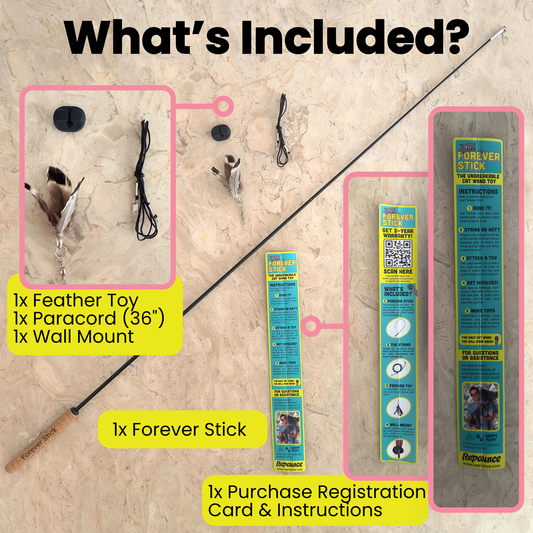
The wand we use for this
The Forever Stick™: a springy glass fiber rod, a cork handle and a 36-inch paracord string you can replace when it wears. Made for daily play.
A sample day for a cat who always wants to play
- Morning: a 10 minute wand session, then breakfast.
- Daytime: a puzzle feeder and a couple of rotated solo toys.
- Early evening: the main session, 15 minutes of active chasing.
- Before bed: a short, calmer game ending with a catch, then a small meal.
Most playful cats settle noticeably within a week or two of a routine like this.
Should you get a second cat?
A second cat can be a good playmate for a young, social cat, but it is a big decision and not a quick fix. Cats need slow introductions, and not every cat wants company. Our article on cat play dates covers which cats tend to enjoy other cats.
FAQ
Why does my cat want to play at night?
Cats are naturally most active around dawn and dusk. A solid play session before bed, followed by a meal, helps many cats sleep through. Avoid rewarding night-time requests with play.
Can a cat play too much?
Rarely. Most cats stop when they are tired. Watch for open-mouth panting, especially in heavier or older cats, and let them rest.
How do I know when playtime is enough?
A satisfied cat usually eats, grooms and then sleeps after a good session. If your cat is still restless and pestering within minutes, the hunt may not have felt finished. Try a longer chase and a clear catch at the end.
Why does my cat bring me toys all the time?
It is a direct invitation to play. Treat it as a signal and, when you can, say yes with a short session. If it happens constantly, set up regular play times so the requests have a predictable answer.
A cat who always wants to play is a cat with a lot to give. With the right routine, that energy goes into the game, and both of you get more rest.