How Much Playtime Does a Cat Need? (Cats and Kittens)
Share
Most adult cats do well with two or three play sessions a day of about 10 to 15 minutes each, so roughly 20 to 40 minutes in total. Kittens need more, in shorter and more frequent bursts, while senior cats usually prefer several gentle five to ten minute sessions.
The exact number matters less than doing it every day and doing it well: short, active hunts that end with a catch and a meal. Below you will find guidelines by age, the signs your cat is not getting enough play, and a simple daily routine you can start today.
How much playtime does a cat need by age?
| Age | Sessions per day | Length | Style |
|---|---|---|---|
| Kittens (up to about 1 year) | 4 to 6, or whenever they are awake and wild | 5 to 15 minutes | Fast, varied, lots of catching |
| Adults (1 to about 10 years) | 2 to 3 | 10 to 15 minutes | Full hunts with real effort |
| Seniors (about 10+ years) | 2 to 4 | 5 to 10 minutes | Slow, low, gentle |
Treat these as starting points. A young, athletic cat may want longer sessions. A laid-back cat may be satisfied with less. Watch your cat, not the clock.
Kittens
Kittens play almost constantly because play is how they learn to move, hunt and handle their bodies. They tire quickly, then nap, then go again. Many short sessions work better than one long one. This is also the best time to teach that hands are not toys: use a wand or toss toys every time, so biting skin never becomes a habit.
Adult cats
Adult cats need enough play to actually get tired. A good session ends with the cat breathing a little faster, lying down near the toy, or walking off satisfied. Indoor adults in particular rely on you for this, since they cannot hunt outside. Two or three daily sessions also help with weight, boredom and night-time energy.
Senior cats
Older cats still want to hunt, but joints and stamina change. Keep the toy low and slow, drag it along the floor instead of making them jump, and stop before they are worn out. Several gentle mini-sessions are better than one demanding one. Our guide to toys for senior cats has more ideas.
Signs your cat needs more play
Cats rarely tell us directly that they are under-stimulated. Instead, it shows up in behavior:
- Night activity: zoomies, yowling or waking you up at 4 a.m.
- Ankle ambushes and rough play with hands.
- Mischief: knocking things off shelves, opening cupboards, chewing cables or plants.
- Pestering other pets, especially a younger cat bothering an older one.
- Weight gain and low energy. See our tips on helping an overweight cat get moving.
- Constant attention-seeking or meowing at you for no clear reason.
- Over-grooming or sleeping even more than usual out of boredom.
Many of these improve within a week or two of regular play. But some can also point to health problems. If behavior changes suddenly, or comes with appetite changes, weight loss, hiding, or litter box problems, see your vet first.
Free: the Playtime Playbook
Our short guide to daily play that keeps indoor cats happy and healthy. Simple routines, no fancy equipment.
What makes a play session count
Ten good minutes beat thirty minutes of dangling a toy over a sleepy cat. A satisfying session copies a real hunt.
Move the toy like prey
Prey runs away, hides, freezes and dashes off. Drag the toy across the floor, around a chair leg, under a blanket. Pause. Twitch it. Let your cat stalk. Never wave a toy straight in a cat's face, because real prey never runs toward a predator.
Let them catch it
Let your cat make real catches throughout the session, not just at the end. Constant near-misses lead to frustration.
Wind down and feed
Slow the toy down for the last minute, finish with one easy catch, then offer a meal or a small treat. Hunt, catch, eat, groom, sleep is the natural rhythm, and it leaves cats relaxed instead of wired.
Use a toy that holds up
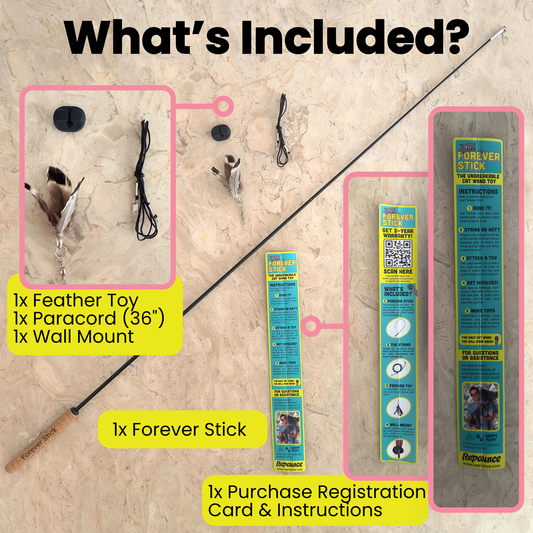
Plenty of owners stop daily play for one simple reason: the wand broke. A durable wand removes that excuse. Our Forever Stick™ has a flexible glass fiber rod that bends and springs back, a 36-inch detachable string, and clasps that fit most attachments, so when a string or feather wears out you replace only that part. It also comes with a wall mount, which keeps the wand in sight for you and out of reach for your cat.
A simple daily play routine
Here is a routine that fits most households with adult cats. Adjust the times to your day.
- Morning (10 minutes): a quick, active hunt before breakfast. Finish with a catch, then serve the meal.
- During the day: leave out one or two safe solo toys (a toss toy, a kick toy) and rotate them every few days.
- Evening (10 to 15 minutes): the main session, at dusk if you can, when cats are naturally active.
- Before bed (5 to 10 minutes): a calmer hunt followed by a small meal or treat. This helps many cats sleep through the night.
If you only have time for one session, make it the evening one, and keep it consistent. Cats love routine, and they will soon start reminding you when it is time.
Does solo play count?
Solo toys are a useful extra, not a replacement. A toss toy, a kick toy or a feather toy left out for the day gives your cat something to bat around while you are busy, and that does help with boredom. But most cats lose interest in a toy that just lies there. What makes a toy feel like prey is movement that reacts to the cat, and that usually takes a person on the other end.
A good balance for most homes: one or two solo toys out at a time, rotated every few days, plus your daily interactive sessions. Food puzzles and treat balls can add a little mental work between sessions too, especially for cats who eat fast or are home alone for long stretches.
How to get more out of every session
- Put your phone away. Your attention makes the toy move better, and you will notice when your cat is ready to catch or stop.
- Rotate toys. Swap attachments every few days. A feather one day, a ribbon the next. A toy that has been hidden for a week often feels new again.
- Play separately in multi-cat homes. A confident cat can hog the toy while a shy one watches. Short one-to-one sessions solve this.
- Respect the stop signal. Lying down, walking away or a twitching, irritated tail means the session is over.
- Stay safe. Always supervise wand and string play, put wand toys away after play, and replace worn parts.
FAQ
Is 10 minutes of play a day enough for a cat?
For some calm or older cats, yes. Most adults do better with two or three sessions of 10 to 15 minutes. If your cat is still restless, active at night or getting into mischief, add a session.
Can a cat play too much?
Healthy cats usually stop on their own when they are tired. Watch for heavy panting or open-mouth breathing, and stop right away if you see it. Frequent panting after light play is worth mentioning to your vet.
Do indoor cats need more playtime than outdoor cats?
Generally, yes. Outdoor cats spend time exploring and hunting, while indoor cats depend on you to give them that activity. Daily interactive play is one of the most important things you can do for an indoor cat.
What is the best time of day to play with a cat?
Early morning and evening match cats' natural activity peaks. A session before meals and one before bed work especially well.
Two or three short sessions, about twenty minutes a day in total, and most homes are much calmer for it.