Best Cat Toys for Indoor Cats: What Keeps Them Active (2026)
Share
The best cat toys for indoor cats are the ones that let them act out a full hunt: stalk, chase, pounce and catch. For most homes, that means a sturdy wand toy for daily interactive play, a couple of solo toys such as feather toys and kick toys, and a puzzle feeder for the hours you are away.
You do not need a huge collection. A small, well-chosen kit used in rotation does more for an indoor cat than a basket of toys nobody touches. Here is what works, what to skip, and how to fit play into an ordinary day.
Why indoor cats need the right toys
Keeping a cat indoors protects them from traffic, predators and many diseases. The trade-off is that an indoor cat misses the movement and problem solving that outdoor life provides. A cat's instincts are built around short, intense bursts of hunting, many times a day. Without an outlet, that energy often shows up in other ways:
- Racing around the house at night
- Pouncing on ankles or hands
- Overeating or gaining weight from inactivity
- Scratching furniture, knocking things off shelves or seeming restless
- Sleeping more than usual and showing little interest in anything
The right toys give that hunting drive somewhere to go. The key word is "right": toys that move like prey and let the cat finish the hunt by catching something.
Interactive toys: the core of indoor play
Wand toys
If you only buy one toy, make it a good wand. A wand lets you move a toy the way prey moves: darting away, hiding behind a chair, pausing, then fluttering up. No solo toy can do that, and it is the type of play most indoor cats respond to best.
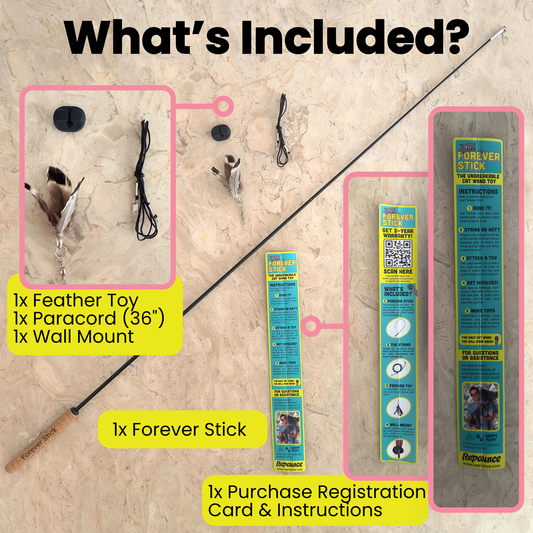
Look for a rod that flexes without snapping, a handle that is comfortable to hold for ten minutes, enough reach that the cat focuses on the toy instead of your hand, and a string you can replace when it wears. Our Forever Stick™ was designed around exactly those points: a springy glass fiber rod, a cork handle, 36 inches of reach and a detachable paracord string. Take the string off and clip a toy straight to the tip for quick moves along the floor, which suits cats who prefer to stalk.
Feather toys
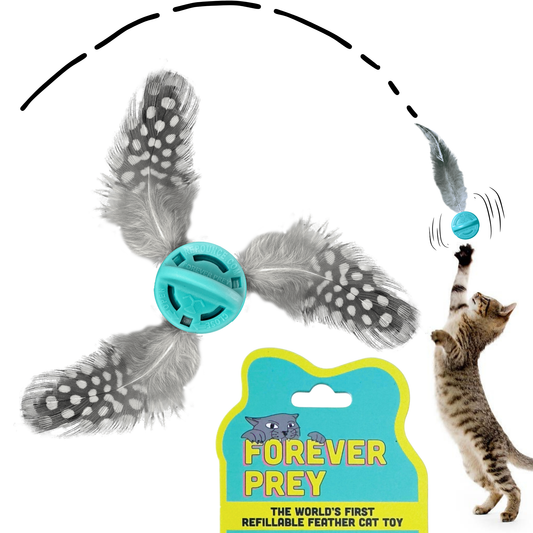
Feathers are the attachment many cats go for first, probably because they look and move like a small bird. Natural feathers tend to flutter more unpredictably than synthetic ones. Our Forever Prey™ is a refillable feather toy: you twist it open and slot in fresh feathers when the old ones get chewed, so the toy itself keeps going. It works on a wand or tossed on the floor for solo play.
Ribbons and fast attachments
Some cats love to leap and twist in the air. Ribbons are light and quick, which makes them hard to catch and great for jumpers. Keep ribbon toys for supervised play and store them afterward, since a cat chewing on a loose ribbon alone can swallow pieces.
Free: the Playtime Playbook
Our short guide to daily play that keeps indoor cats happy and healthy. Simple routines, no fancy equipment.
Solo toys for the hours in between
Solo toys cannot replace playing together, but they help fill the long stretches when you are at work or busy. They work best when they invite the cat to do something specific.
Kick toys and catnip toys
Many cats grab a toy with their front legs and kick it hard with their back legs. That is normal predatory behavior, and a soft kick toy gives it a safe target (much better than your arm). Look for reinforced seams and a size the cat can hug. Our Dino plush has organic catnip, a crinkle sound and reinforced stitching for that reason. Note that not every cat reacts to catnip; for those that do, the effect is usually short, so these toys work well for an afternoon burst.
Balls, crinkle toys and tossable toys
Light balls and crinkle toys that skitter across a hard floor are simple, cheap and surprisingly effective. A tossable feather toy works too. Put one or two out at a time rather than leaving everything on the floor.
Puzzle feeders
Puzzle feeders and treat balls make a cat work for some of their food, which mimics foraging and slows down fast eaters. Start with an easy one so the cat succeeds quickly, then make it harder over time. Part of the daily food portion can go into the puzzle, so you are not adding extra calories.
What to skip or use carefully
- Laser pointers. Fun for many cats, but the hunt never ends with a catch. If you use one, finish by landing the dot on a real toy the cat can grab.
- Toys with small glued-on parts like plastic eyes or bells that can come loose.
- Strings, ribbons and elastic left out unsupervised. Put wand toys away after every session.
How to build a small toy kit
Here is a simple kit that covers most indoor cats:
- One good wand with a replaceable string
- Three or four attachments with different movements: a feather toy, a ribbon and something soft
- One or two kick toys for wrestling
- A couple of small solo toys, like a ball or a tossable feather toy
- One puzzle feeder
- A spare string, especially if your cat chews
If you would rather not piece it together yourself, the Ultimate Toy Rotation bundle covers the attachments, kick toy and spare strings in one box (it does not include a wand, so pair it with one you have or a Forever Stick). The Repounce Starter is the other route: a Forever Stick plus feathers and a pack of replacement strings.
Rotate toys to keep them interesting
Cats often lose interest in a toy that is always lying around. That does not mean they are bored of toys in general, just of that one. Rotation fixes it.
- Keep only two or three solo toys out at a time.
- Store the rest in a closed box or drawer.
- Every few days, swap them for others from the box.
- Change wand attachments between sessions, so one day it is feathers and the next it is a ribbon.
A toy that has been away for a week often gets a reaction like it is brand new. You can read more in our article on why cats get bored of toys.
A simple daily play routine
Two or three short sessions of 10 to 15 minutes a day suit most adult cats. Kittens and young cats may want more, older cats often prefer shorter. A routine that works in many homes:
- Morning: a short wand session before breakfast.
- While you are out: a puzzle feeder with part of the day's food and a couple of solo toys from the rotation.
- Evening: a longer wand session, ideally before dinner or before bed.
Within each session, follow the natural hunt: start slow and let the cat stalk, build up to fast chases and pounces, then slow down again and let the cat catch the toy. Finishing with a catch, followed by a meal or a treat, helps the cat settle afterward. Our guide on how much playtime a cat needs goes into more detail.
Safety basics
Always supervise wand and string play, and put wand toys away after play, out of reach. A wall mount helps with that. Check toys regularly and replace worn strings, frayed feathers and split seams. If your cat suddenly stops playing, seems stiff or sore, or changes their eating or hiding habits, check in with your vet.
FAQ
What toys keep indoor cats busy while I'm at work?
Puzzle feeders are the most effective, since they turn part of a meal into an activity. Add a couple of rotated solo toys, like a kick toy and a tossable feather toy. Keep wand toys and anything with string put away while you are out.
How many toys does an indoor cat need?
Fewer than most people think. One good wand, a few attachments, one or two kick toys, a couple of small solo toys and a puzzle feeder is plenty. Rotating them matters more than the total number.
Do indoor cats need interactive play every day?
Yes, most do. Daily interactive play gives indoor cats exercise, an outlet for their hunting instincts and time with you. Two or three short sessions spread across the day usually work better than one long one.
Are laser pointers bad for indoor cats?
They are not harmful when used carefully (never shine one in a cat's eyes), but some cats get frustrated because they can never catch the dot. End every laser session on a real toy they can grab, and use wands as the main form of play.
Indoor life can be a full, active life for a cat.