Do Cats Get Bored of Toys? How to Rotate Toys to Keep Them Fun
Share
Yes, cats get bored of toys, especially toys that are always lying in the same place and never move on their own. The fix is simple: rotate a small set of toys so each one disappears for a while and comes back feeling new, and keep your interactive play varied.
If you have a drawer full of toys your cat once loved and now walks past, you are not alone. We have one too. The good news is that most of those toys are not broken, just familiar. Below is why novelty matters to cats, a weekly rotation plan that takes a few minutes, and how preferences shift as cats grow older.
Why cats lose interest in toys
To a cat, a toy is prey. Real prey moves, hides, makes small sounds and smells interesting. A toy mouse that has been lying in the hallway for two weeks does none of that. Your cat has already "caught" it many times, and it holds no more surprises.
Cats are also very good at tuning out things that never change. The same toy in the same spot quickly becomes part of the furniture. Take it away for a while and bring it back, and it becomes interesting again. This is why a shoebox of old toys can feel like a new delivery once you start rotating them.
Finally, many toys only come alive when someone moves them. A feather on the floor is a feather. A feather twitching behind a door frame is a bird. If a toy seems boring, the problem is sometimes the movement, not the toy.
Signs your cat is bored
- Ignoring toys they used to chase
- Following you around and meowing for attention
- Night-time zoomies or early morning wake-up calls
- Scratching furniture, knocking things off shelves or raiding counters
- Pouncing on ankles and hands
- Sleeping even more than usual and seeming flat
Boredom is common, but some of these signs can also point to pain, illness or stress. If your cat suddenly stops playing, hides, eats less or seems withdrawn, check with your vet before assuming it is boredom.
A simple weekly toy rotation plan
Toy rotation sounds like a project, but it takes a few minutes a week. Here is the plan we use at home.
Step 1: Gather and sort
Collect every toy in the house. Throw away anything damaged. Then sort the rest into three or four groups, mixing types in each group: something to chase, something to bat, something to wrestle, and something to sniff or investigate.
Step 2: Put most of them away
Leave one group out and store the others in a closed box or cupboard. Storing toys with a pinch of dried catnip or some silvervine can make them smell new when they come back, if your cat likes those scents.
Step 3: Swap once a week
Pick a day, maybe Sunday evening, and swap the group that is out for the next one in the box. After three or four weeks, the first group comes back out and feels fresh again.
Step 4: Keep wand toys separate
Wand toys are not part of the floor rotation. They come out only for play sessions with you and go back up afterwards, which keeps them exciting and keeps strings safe. Always supervise wand and string play.
Step 5: Change attachments daily
Within play sessions, change the attachment on your wand every day or even mid-session. Feathers one day, a ribbon the next, a small plush the day after. Changing just the "prey" is often enough to get a bored cat interested again.
Free: the Playtime Playbook
Our short guide to daily play that keeps indoor cats happy and healthy. Simple routines, no fancy equipment.
Other easy ways to keep toys interesting
- Change the location: leave a toy somewhere new, like inside a paper bag, on a cat tree platform or in an empty box.
- Change the movement: slow creeping one day, fast dashes the next, high flights after that.
- Use sound: rustle a toy behind a curtain or inside a cardboard box before your cat can see it.
- Hide and reveal: let the toy disappear under a blanket and peek out again.
- Add a small reward: ending a session with a treat makes the whole game more appealing next time.
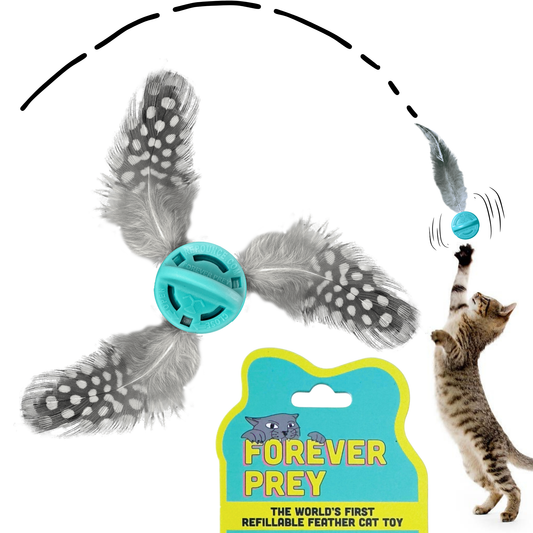
If you want to set up a rotation without buying toys one at a time, our Toy Rotation bundle was put together for this. It includes two Forever Prey™ feather toys with feathers, a Feather Toy Set, a Rainbow Ribbon Set, a catnip Dino plush and two Heavy Chewers Packs, so you have feathers, ribbons and something to wrestle to cycle through. It works with the wand you already have.
In a home with more than one cat, rotation works the same way, but watch who plays with what. One cat may claim a toy and the other may hang back. Having two of the same kind of toy, or playing with each cat separately for a few minutes, helps the quieter cat get a fair turn.
How play preferences change with age
Kittens
Kittens will chase almost anything and play in many short bursts throughout the day. They are learning coordination, so variety matters more than any specific toy. Keep sessions short, and teach them early that hands are not toys.
Young and adult cats
This is when most cats settle into a clear style: stalker, jumper, chaser or wrestler. They often want more challenge than kittens. Make the hunt harder, use the whole room, and let them work for the catch.
Senior cats
Older cats usually still want to play, just differently. They often prefer slower, low movements along the floor, shorter sessions and softer toys. Jumps may be smaller, and that is fine. Our guide to toys for senior cats has ideas that are easy on aging joints.
Preferences can also shift after a change at home, like a move or a new pet. If a favorite toy suddenly loses its charm, try a different type for a few weeks rather than assuming your cat has stopped playing.
Do cats outgrow toys?
Cats rarely outgrow play altogether. They outgrow particular ways of playing. A ten-year-old cat might ignore a ball they loved as a kitten but still crouch and wiggle when a feather creeps along the floor. Their hunting instinct stays with them for life.
What changes is energy, speed and patience. Older cats may need a slower start to a session, more time to watch the toy before they pounce, and a quicker end. If your cat seems uninterested, our tips on how to get a cat to play can help. And if a once-playful cat stops altogether, it is worth a vet visit, since pain from stiff joints is a common reason cats slow down.
FAQ
How often should I rotate my cat's toys?
Swapping the toys that are out about once a week works well for most cats. Keep three or four groups and cycle through them. Change wand attachments more often, even daily.
Can you give a cat too many toys?
Having lots of toys is not harmful, but leaving them all out at once usually backfires. Cats tune out what is always there. A few toys out and the rest in storage keeps each one more interesting.
Should I put cat toys away after playing?
Yes for wand and string toys, which should always be stored out of reach after play. For small solo toys, leave a few out and keep the rest in rotation so they stay new.
Why does my cat only like one toy?
Some cats have a strong favorite, often because it matches their play style perfectly. That is fine. Keep it in good repair, and try new toys with a similar texture or movement to widen their options.
Rotation is one of the easiest ways to get more play out of the toys you already own. Give it two or three weeks, and you may find your cat greeting old toys like long-lost prey.