Are Feather Toys Safe for Cats? Real vs Fake Feathers
Share
Many cat toy feathers are real. Most come from chickens, roosters, turkeys, guinea fowl or pheasants, and they are usually a byproduct of the poultry industry. Others are synthetic, made from polyester, nylon or plastic shaped to look like feathers. Real feathers are often dyed bright colors, so a feather can be real and still not natural.
For most cats, real, undyed feathers are the most exciting and the simplest choice, as long as you buy from a brand that explains how its feathers are sourced and you supervise play. Here is how to tell the types apart, what matters for safety, and how to choose.
How to tell if a cat toy feather is real
Packaging does not always say. These quick checks help:
- Look at the shaft. Real feathers have a hollow quill that tapers to a point. Synthetic ones often have a flat or molded plastic spine, or none at all.
- Look at the vanes. Real feather vanes are made of tiny barbs that split apart and zip back together when you smooth them. Synthetic "feathers" are usually cut from one piece of material and do not separate the same way.
- Watch it move. Real feathers are very light and flutter, spin and drift with the smallest air movement. Synthetic ones tend to flop or hang stiffly.
- Check the color. Neon pink, electric blue or perfectly even color usually means dye. Natural feathers show soft, uneven patterns: speckles, bars, dots and shading.
Real vs. synthetic feathers
Real feathers
Real feathers move the way a bird or a big insect would, which is exactly what triggers a cat's hunting instinct. Unlike a laser dot, a feather is also something your cat can actually catch (more on that in are laser pointers bad for cats). They are light enough to flutter unpredictably and soft enough to grab and bite. In our experience, most cats choose real feathers over synthetic ones when given both.
The downsides: they wear out. Barbs break, quills bend, and a feather toy that gets caught and chewed every day will look tired within weeks. That is normal, and it is why replaceable feathers make sense.
Synthetic feathers
Synthetic feathers avoid animal products, which matters to some owners, and they can hold up longer to chewing. But they usually move less like prey, and many cats lose interest faster. They are also mostly plastic, so once they are worn out, they become waste that will not break down.
Which is better?
If your cat plays happily with synthetic feathers and that fits your values, that is a fine choice. If your cat ignores synthetic toys, try real, undyed feathers before you decide your cat "does not like feathers." The difference in movement is often what matters.
Dyed vs. undyed feathers
Many real feathers are bleached and dyed to look bright on a store shelf. Cats do not need the color. They see blues and yellows but not the reds and pinks we do, and they care far more about movement than color.
Undyed feathers keep things simple. There is no dye to rub off on carpets, run when the toy gets wet with saliva, or end up in your cat's mouth when they chew. If you buy dyed feathers, choose a brand that tells you what it uses, and stop using any feather that leaves color on your fingers.
Free: the Playtime Playbook
Our short guide to daily play that keeps indoor cats happy and healthy. Simple routines, no fancy equipment.
Are feather toys safe for cats?
Feather toys are safe for most cats with a few sensible habits:
- Supervise play. Feather wands and string toys are for playing together, not for leaving out.
- Do not let your cat eat the feathers. Chewing on a feather during a catch is normal. Shredding and swallowing pieces is not. Swap in a sturdier toy for cats who do this.
- Replace worn feathers. A feather with a broken, sharp quill or lots of missing barbs is done. Our guide on when to replace cat toys covers what to look for.
- Check how feathers are attached. Loose glue or flimsy binding can let feathers or small parts come off.
- Store toys away after play. This keeps cats from chewing them unsupervised and keeps the toy exciting.
Feather allergies in cats are uncommon, but if you notice sneezing, itching or skin irritation that seems linked to feather toys, stop using them and talk to your vet. The same goes for any signs of vomiting, gagging or a cat that stops eating after a play session, which could mean something was swallowed.
Ethical sourcing: what to ask
This is the part of the feather question we get asked about most, and it is a fair one. Most feathers used in cat toys come from birds raised for food, so the feathers are collected after the fact. The real concern is live plucking, where feathers are pulled from living birds. It is painful and something no cat toy needs.
Before you buy, look for clear answers to these questions:
- Which bird do the feathers come from?
- Are they a byproduct, and does the brand confirm they are never plucked from live birds?
- Are they dyed, and with what?
- Can you replace just the feathers, or do you throw away the whole toy?
A brand that cannot answer those is worth a second thought.
How to choose a good feather toy
For solo play and carrying
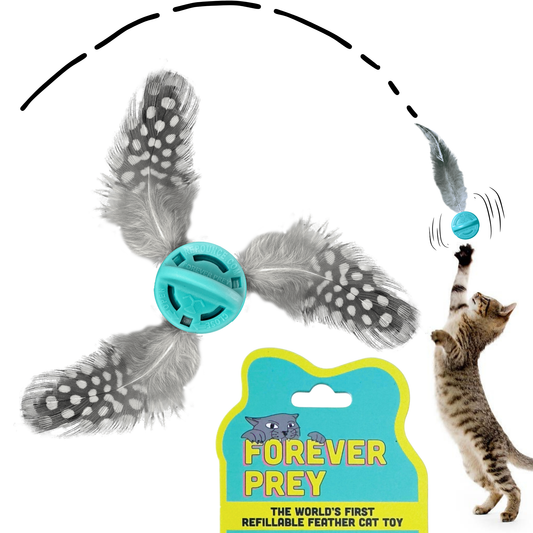
Cats love something they can catch, carry off and "kill." We made the Forever Prey™ for exactly that: you twist it open, slot in one to three fresh feathers and twist it shut. You can toss it for solo play, clip it to a wand tip or hang it from the string. It uses natural, undyed, ethically sourced feathers, never live plucked, and the toy itself is 100% recyclable with a lifetime warranty. When the feathers wear out, you replace only the feathers.
The feather toy we made
The Forever Prey™: twist it open, slot in fresh undyed feathers, twist it shut. The toy has a lifetime warranty.
For refills
Short, dotted pearl chicken feathers are our favorite for refills because they flutter in a jerky, unpredictable way that cats find hard to ignore. Our Replacement Feathers come in packs of 10 to 100, so a worn feather never ends the game.
For wand play
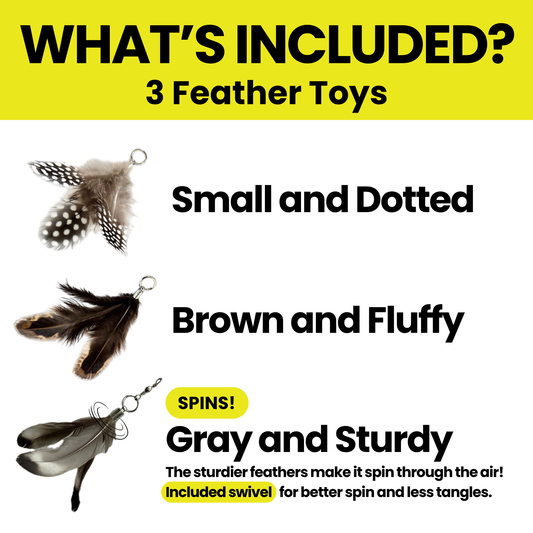
Different feathers fly differently. Long feathers swoop like a bird, short ones flutter like a moth. The Feather Toy Set gives you three to eighteen natural feather attachments with different flight patterns that fit most string-and-rod wands, which makes it easy to rotate and keep things fresh.
For more on making the most of a feather toy, see why you should let your cat catch the toy.
Common myths about cat toy feathers
- "All feathers on cat toys are fake." Many are real, often from poultry. Some are synthetic.
- "Bright colors make feathers more exciting." Color is mostly for us. Movement is what cats respond to.
- "Feather toys are only for kittens." Cats of all ages enjoy them, seniors included. Just slow the game down for older cats.
- "A feather toy should last forever." Feathers are meant to be caught, bitten and worn out. A toy with replaceable feathers is the practical answer.
FAQ
What birds do cat toy feathers come from?
Most real cat toy feathers come from chickens, roosters, turkeys, guinea fowl and pheasants. These are usually byproducts of birds raised for food. A good brand will tell you which bird it uses.
Is it OK if my cat eats a feather?
A small bit of feather is often passed without trouble, but it is not something to allow. Swallowed quills and larger pieces can cause problems. If your cat vomits, gags, seems in pain or stops eating, call your vet.
Are dyed feathers bad for cats?
Not necessarily, but you often cannot tell what dye was used. Undyed feathers remove the question entirely, and your cat will not miss the color.
How often should I replace feathers on cat toys?
Replace them when the quill is bent or broken, or when the barbs are mostly gone. For a cat who plays daily, that might be every few weeks. Refillable toys make this cheap and quick.
In our experience, most cats skip the plastic and go straight for natural, speckled feathers. Movement over color, real over fake: that is the rule we follow, and it has served us well.