Should You Let Your Cat Catch the Toy? Yes, Here Is Why
Share
Yes, you should let your cat catch the toy, several times during a session and always at the end. Catching is the payoff of the hunt. A cat who chases and never catches can end up frustrated, restless or even more likely to pounce on your ankles later.
The trick is balance: enough chase to make the catch feel earned, and enough catches to keep your cat feeling successful. Here is why it matters and how to do it.
Why catching matters: the hunting sequence
Cats are built for a specific sequence, and play works best when it follows it:
- Hunt: watch, stalk, creep, chase.
- Catch: pounce, grab, bite, bunny kick.
- Eat: in the wild, the reward for a successful hunt.
- Groom: clean up and settle down.
- Sleep: rest and recharge for the next hunt.
When play skips the catch, the sequence stops halfway. Your cat is left switched on with nowhere to put that energy. When play includes the catch, then a meal or treat, cats move naturally into grooming and a nap. That is the calm, satisfied cat most of us are hoping for.
The problem with laser pointers
Laser pointers are the clearest example of a hunt with no ending. The dot moves beautifully, your cat chases hard, and then there is nothing to grab. Some cats handle it fine. Others get visibly wound up afterward: searching the floor, staring at reflections, pouncing at shadows or acting restless.
If you use a laser, finish by landing the dot on a physical toy your cat can catch, or switch to a wand for the last few minutes. And never shine it near your cat's eyes. We cover this in more detail in our article on laser toys and cat safety.
How often should your cat catch the toy?
There is no fixed rule, but a good rhythm for most cats is a catch every few chases. Let your cat really work for some, and give others more easily. Watch their mood:
- Confident, energetic cats enjoy a challenge. Make them work harder between catches.
- Shy, older or new players need early success. Let them catch within the first minute so they stay interested.
- Frustrated cats (tail lashing, swatting wildly, giving up) need an easy catch right away.
When your cat catches the toy, let them hold it. Let them bite, kick and carry it a few steps. Then gently tease it free by making it "come back to life" with a small twitch, rather than yanking it out of their mouth.
Free: the Playtime Playbook
Our short guide to daily play that keeps indoor cats happy and healthy. Simple routines, no fancy equipment.
How to run a satisfying session
1. Start slow
Begin with the toy partly hidden or moving slowly at a distance. Let your cat notice it and start to stalk.
2. Move it like prey
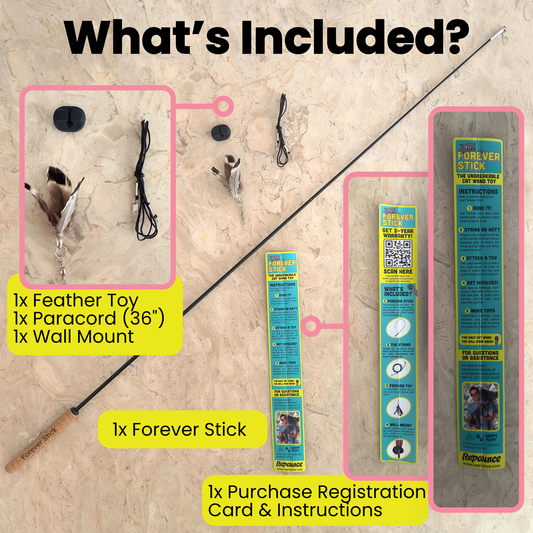
Prey moves away from a predator, not toward it. Drag the toy across the floor, behind a chair leg, under the edge of a rug. Pause, twitch, then dash. Mix ground runs with short hops into the air. A wand makes this easy. With our Forever Stick™, you can unclip the 36-inch string and attach a toy right to the springy rod tip for quick, darting runs, or clip the string back on for swooping, bird-like flights.
For more on wand technique, read how to use a cat wand.
3. Let them win, often
Give real catches throughout. A catch every few chases keeps your cat engaged and confident.
4. Build to a peak
Around the middle of the session, make the hunt more active: longer runs, quicker turns, a few jumps if your cat enjoys them.
5. Wind down
For the last minute or two, slow the toy down, as if the prey is tired. Your cat's breathing and pace will slow too.
6. End with a final catch
Let your cat make one last, easy catch and keep it for a moment. This is the most important part of the session.
7. Feed
Serve a meal or a small treat right after. That completes the hunt, catch, eat sequence and helps your cat settle into grooming and rest.
Give them something to carry off
Many cats want to do more than catch. They want to carry their prize away, guard it and "kill" it with bites and kicks. That is a natural, healthy part of the hunt.
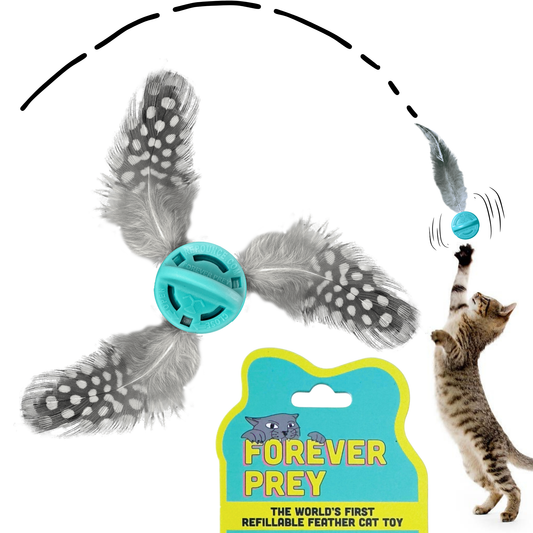
A small toy that can come off the wand is perfect for this. We designed the Forever Prey™ so it can clip to a wand tip, hang from the string, or be tossed on its own. After a wand session, you can unclip it and let your cat carry it off as the final trophy. It holds one to three natural, undyed feathers that you can refill when they wear out.
A quick safety note: always supervise wand and string play, put wand toys away after play, and replace worn parts. Strings and feathers are for playing together, not for unsupervised chewing.
What if my cat will not let go of the toy?
That is a good sign: the catch felt real. Do not pull or tug, since that turns the game into tug of war and can hurt teeth or encourage biting. Wait a few seconds, then make the string twitch gently so the toy seems to wriggle. Most cats loosen their grip to pounce again. If your cat is clearly done and wants to keep the prize, let them, as long as you are nearby. Then pick the toy up once they have walked off to eat or groom, and put it away until next time.
Signs your cat is satisfied
- They carry the toy away, or lie down holding it.
- Their breathing is a little quicker but relaxed.
- They eat, groom and then nap.
- They stop ambushing ankles later in the evening.
If your cat still seems wired, the session may have been too short, too frustrating, or missing a proper final catch. Try adding a few more easy wins and a slower wind-down.
FAQ
Should I let my cat win when playing?
Yes. Winning, meaning catching the toy, is what makes play satisfying for a cat. Let them win regularly during the session and always at the end.
Why does my cat get frustrated during play?
Usually because the toy is too hard to catch, moves unnaturally, or the session never ends with a catch. Slow down, let your cat grab the toy, and finish with an easy win and a treat.
How do I end a play session without my cat getting upset?
Wind down gradually, let your cat make a final catch, then offer food. Put the wand away out of sight afterward so the game is clearly over.
Is it bad to play with a laser pointer?
Not necessarily, but it can leave some cats frustrated because there is nothing to catch. End every laser session on a physical toy, and never point the beam at your cat's eyes.
A catch, a snack, a wash and a nap: that is how you know the game went well.