Are Laser Pointers Bad for Cats? What to Know Before You Play
Share
Are laser pointers bad for cats? Not automatically, but they come with two real risks: eye damage if the beam hits your cat's eyes, and frustration, because your cat can never actually catch the dot. Used briefly and carefully, and always finished with a real toy your cat can grab, a low-power laser can be part of playtime. It just should not be the whole of it.
Lasers are not evil, and plenty of cats adore them. But a laser pointer is a tool with limits, and knowing those limits is what keeps the game fun for your cat. Here is what to know about eye safety, why the no-catch problem matters more than most people think, and how to use a laser well if your cat loves it.
Why cats love the laser pointer
A small, fast, darting dot looks a lot like a bug or a mouse making a run for it. It switches on the stalk, chase and pounce part of your cat's hunting sequence almost instantly, which is why even sleepy cats will sprint after it. For people, it is easy: you can play from the sofa, with almost no effort, in a small room. It is no surprise it became one of the most popular ways to play with an indoor cat.
The trouble is that a cat's hunting sequence does not end with the chase. It ends with grabbing, biting and "killing" the prey. A laser dot delivers the first half and never the second.
Are laser pointers bad for cats' eyes?
A laser beam shone straight into an eye can damage the retina, and cats are no exception. The risk depends on the power of the laser and how long the light hits the eye. A few basic rules keep things safe:
- Never shine the beam at your cat's face or eyes. Keep the dot on the floor, ahead of your cat.
- Use a low-power laser toy made for pets, with a clear label such as Class 1 or Class 2, rather than any pointer you happen to have.
- Avoid high-power lasers, including those sold as extra strong or for astronomy, and anything without a clear power rating.
- Watch for reflections from mirrors, glass doors and shiny surfaces, which can bounce the beam back into eyes.
- Never point it at people or other pets, and keep it away from children.
If your cat squints, keeps rubbing an eye, has a cloudy or red eye, or seems to bump into things, see a vet promptly.
The bigger problem: there is nothing to catch
For most cats, the eye risk is easy to avoid. The harder issue is behavioral. When a cat chases and chases but never gets the reward of a catch, play can end in frustration rather than satisfaction. Some cats keep searching for the dot after it is gone, stay wound up, or turn that energy on your ankles or another pet.
Some cats can also become fixated on lights, chasing reflections, shadows or phone screens long after the game has ended. Frequent, long laser sessions seem to make this more likely. If your cat starts staring at walls, hunting for light spots or seems unable to settle, stop using the laser and talk to your vet, who may refer you to a behavior specialist.
Being able to catch the toy is a big part of why play feels good to a cat. We go into this in our post on whether you should let your cat catch the toy.
Free: the Playtime Playbook
Our short guide to daily play that keeps indoor cats happy and healthy. Simple routines, no fancy equipment.
How to use a laser pointer cat toy well
If your cat loves the laser, you do not have to throw it away. Treat it as a warm-up or a small part of a session, not the main event.
- Keep it short. A few minutes of laser chasing is enough. Long sessions are where frustration builds.
- Move it like prey. Let the dot dart away, hide behind a chair leg, pause, then run again. Skip frantic zigzags up the walls, which can lead to awkward jumps and landings.
- Let the pounce land. When your cat pounces, stop the dot under them for a moment so the move feels like it worked.
- End on a real toy. Finish by settling the dot on a toy your cat can grab, like a plush toy or a feather, and let them pounce on it and bite it. A small treat afterwards also helps close the hunt.
- Put the laser away. Do not leave it lying around where kids or guests might shine it about for fun.
Signs the laser is not working for your cat
Every cat is different. Watch how your cat behaves after a session, not just during it. A cat that settles down, grooms and naps has had a satisfying game. A cat that keeps pacing, searching corners, chasing reflections or pouncing on your feet is telling you the game left them wound up. If that happens regularly, cut the laser and lean on toys your cat can catch.
Better alternatives to the laser pointer
A wand toy with a feather
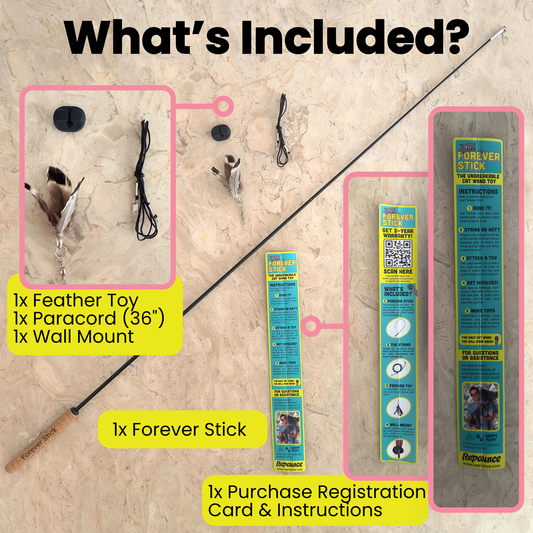
A wand gives your cat everything a laser does (the stalk, the chase, the sudden dart) plus the part a laser cannot: something real to catch. The Forever Stick™ has a springy glass fiber rod and 36 inches of reach, and you can unclip the paracord string for fast moves along the floor that feel a lot like laser play.
A toy to "kill" at the end
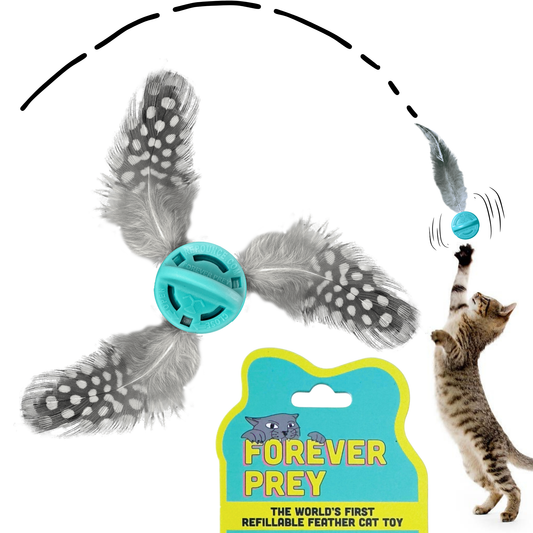
A good hunt ends with a capture. The Forever Prey™ is a refillable feather toy you can clip to the wand tip, hang from the string, or toss for your cat to carry off and bite once the chase is over. When the feathers get tired, twist it open and slot in fresh ones.
A simple routine that works: a short laser warm-up if your cat enjoys it, then switch to the wand for most of the session, and finish by letting them catch and "kill" a toy. Always supervise wand and string play, and put wand toys away afterwards.
FAQ
Can a laser pointer blind a cat?
A laser shone directly into a cat's eye can damage the retina, and high-power lasers carry the greatest risk. Keep the beam away from the face, use a low-power laser made for pets, and see a vet if you notice any change in your cat's eyes or vision.
Is it cruel to play with a laser pointer with your cat?
It is not cruel in itself, but laser-only play can leave cats frustrated because they never catch anything. Keep sessions short and always finish with a real toy they can grab.
Can laser pointers cause obsessive behavior in cats?
Some cats become fixated on lights and reflections, especially after frequent laser play. If your cat seems unable to stop hunting for light spots, stop using the laser and ask your vet for advice.
How long should I use a laser pointer with my cat?
A few minutes is enough, as a warm-up within a longer play session. Two or three sessions of 10 to 15 minutes a day suit most adult cats, and most of that time is better spent with toys they can catch.
We test our toys at home with Tolstoy and Gorba, and our view on lasers is simple: fine as a short warm-up, but the best part of play is the catch.