How to Use a Cat Wand (So Your Cat Actually Plays)
Share
To use a cat wand well, move the toy like small prey: away from your cat rather than toward it, in short bursts with pauses, slipping out of sight and back again. Let your cat catch it often, keep sessions to about 10 to 15 minutes, finish with a final catch, and put the wand away afterward.
Many cats who "don't like wand toys" have simply never seen one moved the right way. A feather waved in front of the face is about as exciting to a cat as a mouse that walks up and introduces itself. Here is how we play at home with Tolstoy and Gorba, step by step.
Before you start
Timing helps. Most cats are naturally most active around dawn and dusk, and many are keen to play just before a meal. A cat who has just eaten and settled into a sunbeam is unlikely to join in, so pick a moment when your cat is awake and curious. If you are not sure, our guide to the signs your cat wants to play covers what to look for.
Clear a little space, move anything fragile, and give the wand a quick check: no frayed string, no loose feathers, no cracks in the rod. Then sit or stand somewhere comfortable. With a long wand you can play from the sofa, which makes daily play much easier to keep up.
Move it like prey
Everything about good wand play comes back to one idea: the toy should behave like something a cat would hunt. Small prey is cautious, it hides, and it tries to escape.
Move away, not toward
Real prey never runs at a cat. Drag the toy across your cat's line of sight and away from them, as if it is trying to get to safety. A toy that retreats invites a chase. A toy that charges at your cat often makes them back off or swat at it defensively.
Use short bursts and pauses
Move, stop, twitch, move again. A mouse does not run in smooth circles, it darts, freezes and listens. The pauses are where the magic happens: watch your cat's pupils widen, their body lower and their back end wiggle as they get ready to pounce. Small twitches while the toy is still are often more exciting than big movements.
Hide and reveal
Let the toy disappear behind a chair leg, under the edge of a blanket or around a door frame, then peek it back out. Cats love a target that keeps vanishing. A couple of cardboard boxes or a paper bag on its side make good hiding spots, and you can turn them into a simple obstacle course for the toy to weave through.
Ground play vs air play
Most toys can be played two ways, and most cats have a favorite.
Ground play
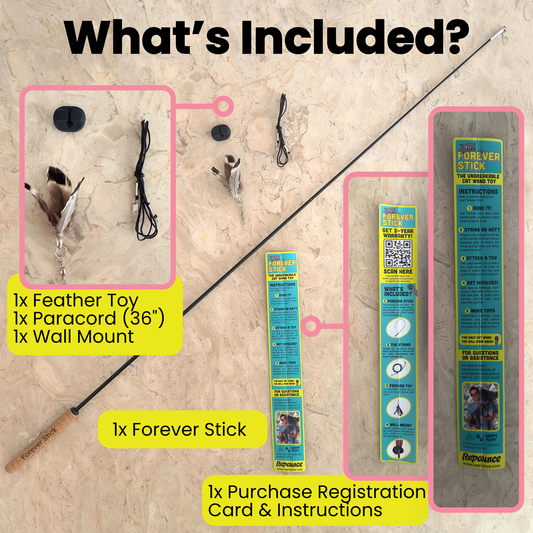
Drag the toy along the floor, under furniture and along walls, like a mouse or a lizard. This suits nearly every cat, and it is the best place to start with a shy cat, a senior or a cat who is new to wand play. It also lets your cat stalk, which is a big part of the fun. On the Forever Stick™ you can unclip the string and attach a toy straight to the rod tip for quick, controlled moves along the floor.
Air play
Flick the toy through the air like a bird or a moth and let it land now and then. Jumpers love this. Keep most jumps modest and let your cat land on a rug or carpet rather than a hard, slippery floor. For seniors, heavier cats and kittens, stick mostly to the ground and the low air, where they can still leap without straining.
The best sessions mix both. A feather can skitter across the floor, flutter up onto the arm of the sofa and then drop back down to hide behind a cushion.
Free: the Playtime Playbook
Our short guide to daily play that keeps indoor cats happy and healthy. Simple routines, no fancy equipment.
Pace the session
A good session has a shape, a bit like a real hunt:
- Warm up. Start slow and quiet. Let your cat watch and stalk the toy from a distance.
- Build. Add faster dashes, longer chases and a few jumps.
- Peak. A few minutes of your cat's favorite moves, with plenty of pounces.
- Wind down. Slow the toy again so it looks tired and easy to catch.
Two or three short sessions of 10 to 15 minutes a day suit most adult cats. Kittens often want more, shorter bursts, while older cats may prefer gentler, shorter sessions. Watch your cat rather than the clock. If your cat starts breathing with an open mouth or panting, stop and let them rest. Cats are not built to pant like dogs, so if it happens often or after only light play, it is worth mentioning to your vet.
Let your cat catch it
This is the step people skip most. A cat who chases and chases but never catches anything can end up frustrated instead of satisfied. Let your cat win often, especially toward the end of the session.
When your cat catches the toy, let them hold it for a moment. Many cats bite, grab with their front feet and kick with their back legs, and that is all part of the hunt. Then make the toy "escape" by slackening the string and slowly drawing it away, rather than yanking it out of their mouth. That keeps the game going and is gentler on your cat's teeth and on the wand. We look at this in more detail in should you let your cat catch the toy.
End the session well
In the wild, a hunt ends with a catch, a meal, a groom and a nap. You can copy that at home. Slow the toy down, let your cat make one last big catch, then offer a meal or a small treat. Many cats will groom and settle afterward, calm and content.
Ending this way also helps with cats who keep pestering you after play stops. The game has a clear finish, so your cat does not feel the prey simply vanished mid-hunt.
Keep it fresh
Cats can get bored of the same toy moved the same way. A few easy ways to keep wand play interesting:
- Swap attachments. Feathers one day, a ribbon or a plush toy the next. Different toys move differently and appeal to different hunting moods.
- Use height. Run the toy up a cat tree or along a low shelf so your cat climbs and leaps.
- Change rooms. New furniture to hide behind makes an old toy feel new.
- Take turns with multiple cats. In a multi-cat home, a confident cat can hog the toy. Play with each cat separately, or use two wands at once with a helper.
Safety and storage
A few rules keep wand play safe:
- Always supervise. Strings can be chewed and swallowed, which can need emergency vet care.
- Put the wand away after play. Store it out of reach, on a wall mount or in a closed cupboard. This also keeps the toy special.
- Replace worn parts. Swap frayed strings and tattered attachments before they come apart.
- Keep the toy away from faces. Never flick it at your cat's eyes, and keep it out of reach of small children's swinging arms.
- Read the mood. If your cat's tail lashes, ears flatten or play turns into hard biting, slow down or pause.
- Never use your hands as the toy. The wand keeps a safe distance between claws and skin, which is one of its best features.
FAQ
Why does my cat ignore the wand toy?
Usually the movement is too big, too predictable or too close. Try small twitches, moving the toy away from your cat and letting it disappear behind furniture. Timing matters too, so try again before a meal or in the evening.
How long should I play with my cat using a wand?
Two or three sessions of 10 to 15 minutes a day suit most adult cats. Kittens may want more frequent short bursts, and seniors often prefer gentler sessions. Stop if your cat pants or loses interest.
Should I let my cat catch the wand toy?
Yes, often. Catching is the satisfying end of the hunt, and a cat who never catches anything can get frustrated. Let them hold, bite and kick it, then slowly let it escape again.
Can wand play help with nighttime zoomies?
For many cats, yes. A proper play session in the evening, followed by a meal, often helps cats settle for the night. It will not change every cat overnight, but it is worth trying for a week or two.
Watch your own cat for a few sessions and you will soon know which kind of hunter you live with.