10 Signs Your Cat Wants to Play (And How to Respond)
Share
A cat who wants to play usually tells you with a mix of body language and behavior: dilated pupils and a fixed stare, a low crouch with a wiggling rear end, a twitching tail tip, chirps or meows aimed at you, bringing you a toy, or ambushing your ankles. The best response is a short, active play session right away, ideally with a wand toy, ending with a catch and a small treat.
Some cats are obvious about it. Others are subtle, and their play requests get mistaken for clinginess, restlessness or "bad behavior." Here are the signs to look for, and what to do with each one.
10 signs your cat wants to play
1. Dilated pupils and a locked stare
When a cat's pupils widen and they fix their eyes on a moving object (a bug, a shadow, your shoelace), the hunting part of the brain has switched on. If the stare is soft and the body is loose, that is interest, not fear.
2. The crouch and butt wiggle
A low crouch with the back end shuffling side to side is the classic pre-pounce. It means "I am about to launch." Few signals are clearer than this one.
3. A twitching tail tip
A tail held still with just the tip flicking signals focused excitement. Be careful not to confuse it with a tail that thrashes hard from side to side, which usually means irritation.
4. Ears forward and swiveling
Upright, forward ears that turn toward sounds mean an alert, curious cat. Flattened ears are the opposite, so if you see those, give the cat space.
5. Chirping, trilling or chattering
Many cats chatter at birds through the window. That hunting excitement often spills over into play. Trills and chirps directed at you are often an invitation.
6. Meowing at you and leading you somewhere
Some cats will meow, walk a few steps, look back, and wait. If you follow and end up at their favorite toy, or at the cupboard where the wand lives, you have your answer.
7. Bringing you a toy
Dropping a toy at your feet (or in your shoe, or on your pillow at 5 a.m.) is about as direct as cats get. It is a request to make the prey move.
8. Ambushing ankles and attacking hands
A cat who hides behind doors and pounces on feet usually has unused hunting energy, not a grudge. It is a play request, delivered badly. Read our guide on how to tell cat play from aggression if you are unsure which one you are seeing.
9. Zoomies and sudden sprints
Racing up and down the hallway, often in the evening, is a release of pent-up energy. It is a sign your cat could use a proper hunting session.
10. Knocking things off tables and getting into mischief
Batting pens off desks, opening cupboards and pestering other pets are often boredom in action. Cats do this because it works: it makes things move and gets your attention.
Free: the Playtime Playbook
Our short guide to daily play that keeps indoor cats happy and healthy. Simple routines, no fancy equipment.
How to respond when your cat asks to play
Say yes quickly, and keep it short
You do not need a long session. Five to ten minutes of real, focused play when your cat asks is worth far more than half an hour of half-hearted dangling later. Two or three short sessions of 10 to 15 minutes a day suit most adult cats.
Use a toy that moves like prey
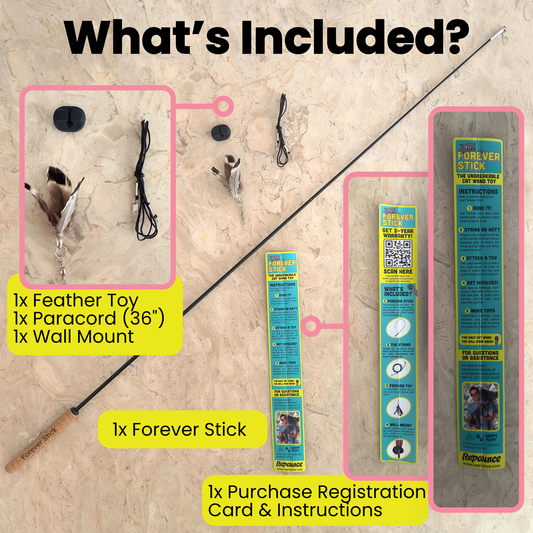
Cats respond to movement that looks like a mouse or bird: darting away, hiding, freezing, then dashing off again. A wand toy lets you do this from a comfortable distance and keeps hands out of the line of fire. Our Forever Stick™ has a springy glass fiber rod and a 36-inch string, and you can unclip the string and attach a toy straight to the tip for fast, low runs along the floor.
Match the toy to the mood
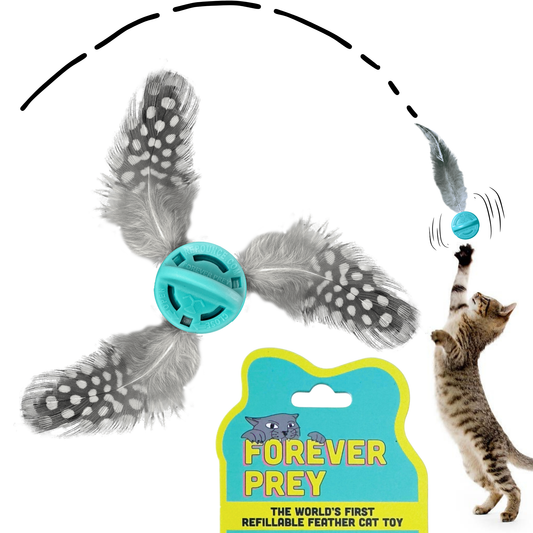
A cat watching birds at the window may want a flyer. Feathers that flutter and swoop through the air are a great fit, and the Feather Toy Set gives you a few different flight patterns to try. A cat ambushing ankles may prefer a ground hunt, with the toy scurrying behind furniture.
Let them catch it
Let your cat win several times during the session, and always at the end. A hunt with no catch is frustrating, which is why laser pointers can leave cats wound up.
Finish with food
End with a slow final chase, a catch, then a meal or a small treat. Hunt, catch, eat, groom, sleep is the natural sequence, and completing it helps your cat settle.
What if your cat never seems to ask?
Some cats are quiet about wanting to play, especially shy cats, older cats and cats who have learned that nobody responds. That does not mean they do not want to play. Try these:
- Play at dawn or dusk. Cats are naturally most active around those times.
- Go slow. Move the toy away from the cat, not toward them. Prey never charges a predator.
- Hide the toy. Drag it behind a chair leg or under a blanket. Partial hiding is often irresistible.
- Rotate toys. A toy that has been out of sight for a week can feel brand new.
- Keep it short and positive. Even a few swats count. Build from there.
Our article on how to get a cat to play goes deeper on reluctant players.
When "wanting to play" is something else
Restlessness, constant meowing or night activity are usually about energy and routine. But if a cat suddenly becomes much more vocal, restless or clingy than usual, especially an older cat, it is worth a vet visit to rule out pain, thyroid problems or other health issues. The same goes for a playful cat who suddenly stops playing.
Always supervise wand and string play, put wand toys away after play, and replace worn parts.
FAQ
How do I know if my cat is bored?
Bored cats often over-groom, sleep more than usual, get into mischief, pester other pets, or meow at night. Many become more playful as soon as they get two or three proper play sessions a day. If boredom signs come with appetite or litter box changes, check with your vet.
Why does my cat bring me toys at night?
Cats are most active around dawn and dusk, so night requests are common. Try a solid play session right before bed, followed by a meal. Many cats then sleep through until morning.
Does tail wagging mean a cat wants to play?
Not always. A tail held up or a gently flicking tip often means interest or excitement. A tail that thrashes hard or thumps the floor usually means irritation, so slow down or stop.
What time of day do cats like to play most?
Most cats are most active in the early morning and evening. Those are good times for your main sessions, but the best time is simply whenever your cat is asking and you can give a few minutes of full attention.
Every cat has their own way of asking. Once you learn it, saying yes gets easy.