How to Choose a Cat Wand: 7 Things That Matter
Share
To choose a cat wand, look at seven things: rod length and flex, whether it has a string, how attachments are fastened, the handle, durability and replacement parts, your cat's play style, and safety. The right wand is the one that matches how your cat likes to hunt and that you will happily pick up every day.
There is no single best wand for every cat. A gentle senior and a kitten who climbs the curtains need different things. Here is the checklist we use at home with Tolstoy and Gorba, from most to least obvious.
1. Rod length and flex
Length sets how far your hands are from the action. Most wands are somewhere between about 15 and 40 inches. A longer rod lets the toy move freely away from you, keeps claws away from your fingers, and lets you play from the sofa without leaning over. Around 30 to 36 inches suits most homes.
A shorter wand can be easier in a small apartment or for close, gentle play with a kitten or senior. But very short wands keep the toy close to your hand, which can teach a cat to pounce near your fingers.
Flex matters as much as length. A good rod is firmer near the handle, so you have control, and springy at the tip, so small wrist movements turn into lively, darting motion. A very stiff rod makes the toy move mechanically. A very floppy one gives you no control at all.
2. String or no string
A string lets the toy swing, flutter and skitter in ways that look more like real prey, and it gives you more reach. The downside is that strings need supervision, because some cats chew them.
A wand without a loose string (where the toy sits on a short wire or straight on the rod tip) gives you precise control for fast floor moves and is lower risk for chewers. It moves less freely in the air.
A detachable string gives you both. Use it for air play and big chases, and take it off for quick moves along the floor or for a cat who tends to chew.
3. Attachments and clasps
Look at how the toy is fastened. If it is glued or permanently tied on, the wand ends when the toy wears out. A clasp at the end of the string (and ideally at the rod tip too) lets you swap toys in seconds and replace worn ones.
Universal clasps are the most flexible, because they fit most store-bought attachments as well as a toy your cat already loves. Swapping toys also keeps play interesting, since cats can lose interest in the same toy moved the same way every day.
4. The handle
You will hold the wand for 10 to 15 minutes at a time, two or three times a day if your cat has their way. A comfortable handle makes that much easier. Look for a grip that is not too thin, does not get slippery, and feels good in your hand. Cork, foam and rubber are all pleasant. A bare plastic tube is often the least comfortable.
It sounds like a small thing, but a wand that is nice to hold is a wand you reach for more often.
Weight matters too. A light rod with a comfortable grip is easy to flick with small wrist movements, so you can keep the toy twitching and darting without tiring your arm. If you have stiff hands or wrists, try to hold a wand before you buy, or pick one with a thicker, softer handle.
Free: the Playtime Playbook
Our short guide to daily play that keeps indoor cats happy and healthy. Simple routines, no fancy equipment.
5. Durability and replacement parts
A wand is only as strong as its weakest part. In short: glass fiber or fiberglass rods bend instead of snapping, paracord and similar tough cords last longer than thin ribbon or elastic, and clasps outlast glue and knots. Most importantly, check that replacement strings and attachments are sold separately, so a worn part does not mean a whole new wand.
We go into rod materials, string joints and realistic lifespans in our guide to durable cat wands, so we will not repeat it all here.
A fair note: if your cat is a gentle player, or you just want to find out whether wand play is their thing, a cheap wand is a perfectly reasonable place to start. Durability matters most for strong, grabby cats and daily play.
A warranty is a useful clue as well. A brand that offers one is telling you it expects the wand to hold up to real play.
6. Your cat's play style
This is where most of the fun is. Watch your cat for a few sessions and you will probably notice a favorite way to hunt. Our guide to cat play styles goes deeper, but these are the main types:
Ground hunters
Cats who stalk, crouch and pounce low love toys that skitter along the floor like a mouse. Feathers, small plush toys and short strings work well. A wand you can use without the string is handy for quick, low moves.
Jumpers
Cats who leap after anything in the air love fast, fluttering toys. Long feathers and ribbons are great here. Our Rainbow Ribbon Set was made for jumpers, with satin ribbons in three lengths that are fast and hard to catch.
Wrestlers
Some cats want to grab the toy, hug it and bunny kick it. They need something sturdy and huggable at the end of the string, like a plush with reinforced stitching, rather than a delicate feather.
Chewers
If your cat bites the string more than the toy, choose a chew-resistant string or go string-free, and stay close during play.
Age matters too. Kittens do well with lighter toys and short sessions. Seniors usually prefer slow, low play with fewer big jumps.
7. Safety
- No small glued parts that can come loose and be swallowed.
- A rod that bends rather than snaps, so you are not left with a sharp edge.
- A strong string that suits your cat, replaced as soon as it frays.
- Somewhere to store it out of reach, like a wall mount or closed cupboard.
Whatever you buy, always supervise wand and string play, put wand toys away after play, and replace worn parts.
A quick checklist
- Rod around 30 to 36 inches, firm at the handle and springy at the tip
- Detachable string, or a string-free option for chewers
- Clasps for swapping toys, ideally universal
- A comfortable, non-slip handle
- Replacement strings and attachments available
- Toys that match your cat's play style
- A storage plan that keeps it out of reach
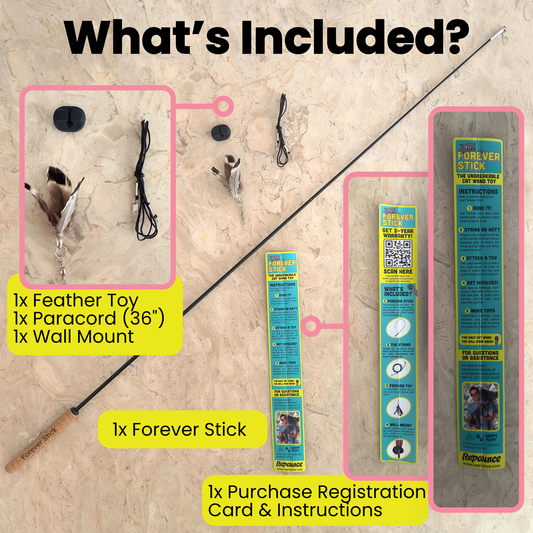
For what it is worth, we built our Forever Stick™ to tick these boxes: a glass fiber rod with 36 inches of reach, a detachable paracord string, universal quick clasps, a cork handle and an included wall mount. It is one good option, not the only one.
FAQ
What length cat wand is best?
For most homes, around 30 to 36 inches works well. It gives the toy room to move, keeps your hands away from claws and lets you play while sitting. Shorter wands can suit small spaces or very gentle play.
Are feathers or strings better for cats?
It depends on the cat. Many cats go wild for feathers in the air, while others prefer a ribbon or small toy sliding along the floor. A wand with swappable attachments lets you try both and rotate.
Are cheap cat wands OK?
Yes, for gentle players and for testing what your cat likes. Check for glued small parts and replace the wand if the rod cracks. For strong, daily players, a sturdier wand with replaceable parts usually works out better.
How many wand toys does a cat need?
One good wand with a few different attachments is enough for most cats. Rotating the toys on the end keeps things fresh without filling a cupboard with wands.
Start with what your cat already loves, and build from there.