Durable Cat Wands: What Actually Lasts (2026 Guide)
Share
A durable cat wand has a flexible rod that bends instead of snapping, a strong string attached with a clasp rather than glue, and parts you can replace when they wear out. No wand survives a determined cat forever, but a well-built one should give you years of play, with only the string and the toys needing a refresh now and then.
If you have bought three wands this year and watched each one snap, fray or lose its feathers within days, this guide is for you. We test every toy at home with our cats, Tolstoy and Gorba, and this is what we have learned about why wands break, what to look for, how long a good one should last, and when a cheap wand is perfectly fine.
Why most cat wands break so quickly
Most wands fail in one of four places. Once you know them, it gets much easier to spot a weak wand before you buy it.
1. The rod material
Many budget wands use a thin, hollow plastic rod. Plastic copes well with a steady load, but a wand rod bends back and forth hundreds of times in a single session. Over time, small cracks form at the point that flexes most, often near the handle, and one day the rod snaps mid-pounce. A snapped plastic rod can leave a sharp edge, so this is a safety problem as well as an annoying one.
Thin wooden dowels have a similar weakness. They look natural, but they can splinter, and they do not cope well with saliva and damp.
2. The string joint
The spot where the string meets the rod is where many wands give up first. A common budget design threads the string through a drilled hole near the tip, ties a knot and adds a drop of glue. The edge of the hole rubs the string every time it goes tight, the glue softens, and the knot slowly works loose. The rod can be perfectly fine and the toy is still finished.
3. Glue everywhere
Glue shows up all over cheap wands: feathers glued into a plastic cap, a toy glued to the string, a string glued into the tip. Cats bite, kick and pull hard, and glue joints are almost always the first thing to fail. It is also how small loose pieces end up on your floor, which is not something you want a cat chewing on.
4. Fixed attachments
When the feather or toy is permanently tied or glued on, the whole wand is only as durable as its most fragile part. Feathers wear out fast, and that is normal (cats are supposed to wreck them). But if the attachment cannot be swapped, a worn feather means buying a whole new wand.
The key point: every wand has a weak spot. A durable wand puts that weak spot in a cheap, replaceable part, like a string or a feather, instead of in the whole toy.
What to look for in a durable cat wand
A glass fiber rod
Look for glass fiber (fiberglass) or a similar composite. These rods bend under load and spring back instead of cracking, which is exactly what wand play asks of them. The best ones are firmer near the handle for control and springy at the tip for lively, prey-like movement. Carbon fiber is strong and light, but stiffer, so it gives less of that whippy motion cats love. If a listing does not say what the rod is made of, assume plastic.
A strong, replaceable string
The string is a wear part on every wand, so two things matter: that it is tough, and that you can replace it. Nylon paracord holds up well to biting and pulling and frays far more slowly than cotton cord or thin ribbon. Elastic strings feel bouncy and fun but tend to wear out quickly. If your cat bites the string a lot, there are coated metal strings too, and we compare all the options in our guide to wand strings for cats that chew.
Clasps instead of glue and knots
A clasp at the rod tip and at the end of the string lets you change strings and toys in seconds, and it does not loosen the way glue and knots do. A universal clasp has a second benefit: you are not locked into one brand's attachments, so you can clip on a toy your cat already loves.
A handle you are happy to hold
A good play session lasts 10 to 15 minutes, so the handle matters more than it seems. A comfortable grip that does not get slippery (cork, foam or rubber all work) makes you more likely to play every day, and daily play is the whole point of owning a wand.
Replacement parts you can actually buy
Before you buy, check whether replacement strings and attachments are sold separately. If they are not, the wand is effectively disposable, however sturdy the rod looks in the photos.
A plan for storage
Many wands are destroyed between play sessions, not during them. A cat who finds a wand on the sofa at 3 a.m. will chew the string and drag the rod around the house. A wall hook or a closed cupboard keeps the wand safe, keeps your cat safe, and keeps the toy feeling special.
Free: the Playtime Playbook
Our short guide to daily play that keeps indoor cats happy and healthy. Simple routines, no fancy equipment.
Durable vs cheap cat wands: an honest comparison
This is how the two types usually compare. Not every wand fits neatly into one column, but these are the patterns we see again and again.
| Typical cheap wand | Typical durable wand | |
|---|---|---|
| Price | About $5 to $15 | About $25 to $40 |
| Rod | Hollow plastic or thin wood | Glass fiber or fiberglass |
| String | Thin cord, ribbon or elastic | Paracord or other tough cord |
| Connections | Glue, knots, drilled holes | Clasps |
| Attachments | Fixed | Swappable |
| When something wears out | Replace the whole toy | Replace the string or toy |
| Warranty | Rare | Often included |
The price gap looks big at checkout, but it shrinks over time. If a $10 wand lasts about a month with an active cat, you spend more on replacements within a year than you would on one durable wand, and you throw away a lot of plastic along the way. If a cheap wand lasts you six months, the math looks different, and that is fine too.
When a cheap wand is the right choice
Cheap wands are not a scam, and plenty of cats do well with them. A budget wand makes sense if:
- your cat is a gentle player who bats at toys rather than grabbing and biting them
- you want to find out whether your cat prefers feathers, ribbons or plush before spending more
- you need a spare for travel or for a pet sitter
- you only play now and then
If your cat is a strong, grabby hunter, you play every day, or you have more than one cat, a sturdier wand usually pays for itself.
How long should a cat wand last?
It depends on which part you mean. A good glass fiber rod should last for years of daily play. It does not tire out from normal bending the way plastic does, so the rod is the part you should rarely have to think about.
The string is a consumable. With an average player, a tough paracord string usually lasts for months. With a cat who chews the string, expect to replace it much more often, or switch to a chew-resistant one. Replace any string that is fraying, thinning or shedding fibers, whatever its age.
Attachments wear out fastest. Feathers, ribbons and plush toys might last a few weeks, depending on how hard your cat plays, and that is a sign they are doing their job. If you are not sure when a toy is past it, our guide on when to throw away cat toys walks through the signs.
A cheap plastic wand, by comparison, often lasts anywhere from a few days to a few weeks with a determined cat, because the rod, the string and the toy all tend to fail at once.
How to make any cat wand last longer
Whatever wand you own, these habits help it go further:
- Put it away after every session. Unsupervised chewing destroys more strings than play does, and a loose string is a real safety risk.
- Let the rod do the work. Keep your movements smooth. Yanking a toy out of your cat's mouth puts the most strain on the string and the joints.
- Play low more often. Many cats prefer a toy that skitters along the floor, and the rod flexes far less than during big, whipping jumps.
- Rotate attachments. Swapping toys spreads the wear and keeps your cat curious.
- Check before you play. Look for frayed string, loose feathers and cracks, and replace worn parts right away.
- Let it dry. A damp, well-chewed string lasts longer if it dries before you store it.
And the most important safety habit of all: always supervise wand and string play, put wand toys away after play, and replace worn parts.
The Forever Stick: one durable option
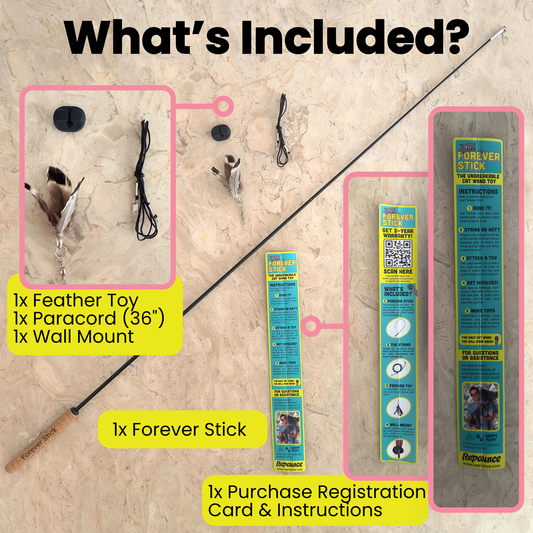
We designed the Forever Stick™ around everything above, after going through far too many wands with Tolstoy and Gorba. It has an ultra-flexible glass fiber rod that is sturdy at the handle and springy at the tip, so it bends and returns to shape. The 36-inch paracord string is detachable, so you can clip it off for fast moves along the floor. Universal quick clasps at the tip and at the string end fit our attachments, store-bought ones, or a toy your cat already loves. It has a natural cork handle, 36 inches of reach, and a self-adhesive wall mount for storage.
When the string or attachment wears out, you replace that part and keep the wand. The wand comes with a 1-year warranty, or 3 years when you register it. You can see all the details on the Forever Stick page. It costs $34.99, ships free in the US, and has a 30-day satisfaction guarantee.
It is not the only good wand out there, and it is not the right buy for every cat. If your cat is a gentle player, a simpler wand may serve you well for a long time. But if you are tired of replacing wands, it is the one we built for our own home.
FAQ
What is the most durable type of cat wand?
Look for a glass fiber or fiberglass rod, a tough replaceable string such as paracord, clasps instead of glue, and swappable attachments. The combination matters more than any single material, because a wand is only as durable as its weakest part.
Why do cheap cat wands break so fast?
Most use hollow plastic rods that crack after repeated bending, thin strings that fray at the tip, and glued-on attachments that pull loose. These parts usually fail together, so the whole toy ends up in the bin.
Can I replace the string on a cat wand?
On wands with a clasp or loop at the tip, yes, and it takes seconds. On many budget wands the string is glued in, so it cannot be swapped. Our Heavy Chewers Pack has three 36-inch strings that fit the Forever Stick and most other wands.
Is an expensive cat wand worth it?
If you play daily with an active cat, usually yes, because you stop replacing the whole toy every few weeks. If your cat plays gently or only now and then, a cheaper wand can be a perfectly sensible choice.
Whatever wand you choose, the best one is the one you actually pick up every day.