Cat Wand Strings for Cats That Chew: What's Safe and What Lasts
Share
For a cat that chews, the safest wand string is a chew-resistant one, such as a coated metal string or a tough nylon cord, used only during supervised play and put away afterward. No string is safe to leave out with a chewer, because swallowed string can cause a serious gut emergency.
If your cat goes for the string instead of the toy, you are not alone. Here is why cats chew wand strings, what the real risks are, how the common string materials compare, and how to keep play safe without giving up wand toys.
Why cats chew wand strings
There are a few common reasons, and many cats have more than one:
- It is part of the hunt. Catching and biting is how a hunt ends. If the toy is hard to grab, the string is the next best thing.
- Texture. Some cats simply love the feel of cord between their teeth.
- Teething. Kittens chew more while their adult teeth come in.
- Boredom or frustration. A cat who never gets to catch the toy may take it out on the string.
It helps to notice when the chewing happens. If your cat bites the string mostly at the end of a long session, they may be tired or frustrated, and a shorter session with more catches can help. If they go for the string from the very first second, it is more likely a texture thing, and a tougher string is the better fix.
Some cats chew and eat non-food items in general, such as plastic, fabric or hair ties. If that is your cat, mention it to your vet, since it is worth checking for an underlying cause.
Why swallowed string is dangerous
String is one of the more dangerous things a cat can swallow. One end can get caught (often under the tongue or in the stomach) while the rest moves on into the intestines. As the gut tries to push it along, the intestine can bunch up on the string and become seriously damaged. This needs urgent vet care, often surgery.
Signs to call your vet right away
- Vomiting, especially repeated vomiting
- Not eating
- Lethargy or hiding
- A sore or tense belly
- Straining in the litter box, or no stool
- Drooling or rubbing at the mouth
- String visible under the tongue or from the rear end
Never pull on a string you can see in your cat's mouth or coming from their rear end. Pulling can cause serious internal injury. Call your vet straight away. If you think your cat has swallowed string, contact your vet even if they seem fine for now, since signs can take time to show.
Free: the Playtime Playbook
Our short guide to daily play that keeps indoor cats happy and healthy. Simple routines, no fancy equipment.
Wand string materials compared
Different strings behave very differently in a chewer's mouth. Here is a simple comparison based on what we see at home and in our own testing.
| Material | Chew resistance | Good to know |
|---|---|---|
| Cotton cord | Low | Soft and pleasant, but frays quickly and sheds fibers that are easy to swallow. |
| Elastic | Low | Bouncy and fun, but wears out and snaps quickly under teeth. |
| Thin nylon | Medium | Smooth and cheap, but sharp teeth can cut through it. |
| Nylon paracord | Good | Strong and slow to fray. If the outer layer is chewed open, replace it. |
| Coated metal | High | Very hard to chew through. The smooth coating protects teeth and gums. |
Which string for which cat
Occasional nibblers: paracord or a tough nylon cord is usually enough. Check it before each session and replace it once it starts to fray.
Dedicated chewers: a coated metal string is the safest bet for play. It is very hard to chew through, so there are no frayed bits to swallow. Check the coating now and then, and replace the string if it is damaged or kinked.
Kittens: they chew while teething, so keep sessions short, stay close and use a sturdy string.
Whatever you choose, remember that chew-resistant does not mean unsupervised. The string makes play safer. Supervision makes it safe.
Supervision and storage
Most string accidents happen when nobody is watching. These habits make the biggest difference:
- Play together, every time. Wand toys are for interactive play, not for leaving out.
- Put the wand away after play. Out of reach, not just out of sight. A cat who wants the string will find it in a basket.
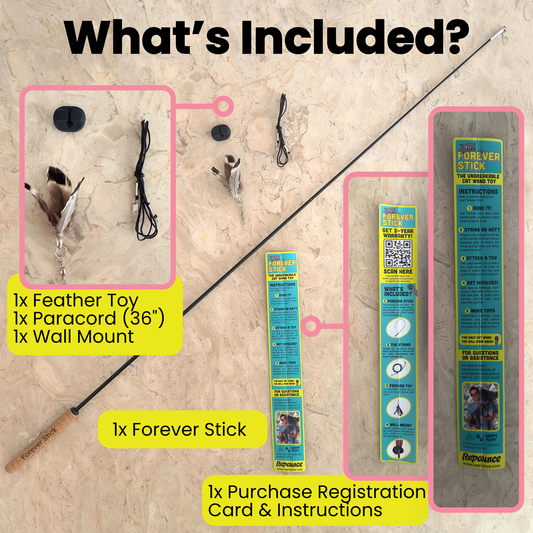
- Use a wall mount or a closed cupboard. Our Wall Mount keeps the wand up out of reach (one comes with every Forever Stick™).
- Check before each session. Look for fraying, thin spots and loose fibers.
Redirect the chewing
If your cat starts gnawing the string mid-game, move the toy so the attachment is easier to catch. Let them win more often, too, since many cats chew the string because the toy feels out of reach. Some cats are happiest with something sturdy to bite and kick. A thick plush toy like our Dino plush, with reinforced stitching for bunny kicks, gives them a better target than the cord.
Good technique helps too. Moving the toy away from your cat, pausing, and ending with a proper catch all reduce frustration chewing. We cover this step by step in how to use a cat wand.
Replace the string, not the wand
On most wands with a clasp or loop at the tip, the string is meant to be replaced. When it wears out, swap it and keep the wand. It is cheaper, less wasteful and quicker than buying a new toy. Replace a string when you see:
- fraying, fuzz or loose fibers
- thin or flattened spots from biting
- a chewed-open outer layer on paracord
- kinks or damaged coating on a metal string
We put together the Heavy Chewers Pack for cats who bite. It has three 36-inch replacement strings: a chew-proof metal string with a smooth coating (with a 1-year warranty), a nylon paracord and an extra-tough nylon string. They fit the Forever Stick and most other wands, and you can rotate them depending on how your cat is playing that day.
If you want more detail on why string joints and materials matter for the whole wand, our guide to durable cat wands covers it.
FAQ
Is it safe for my cat to chew wand strings?
A little chewing during supervised play is common, but swallowing string is dangerous. Use a chew-resistant string, stay close, and put the wand away after every session.
What should I do if my cat swallowed string?
Call your vet right away, even if your cat seems fine. Never pull on string visible in the mouth or from the rear end, as this can cause internal injury. Watch for vomiting, not eating, lethargy or straining.
What is the most chew-resistant cat wand string?
A metal string with a smooth coating is the hardest for a cat to chew through. Nylon paracord is a good second choice for moderate chewers. Cotton and elastic are the weakest.
How often should I replace a cat wand string?
Replace it as soon as it frays, thins or shows loose fibers, whatever its age. For heavy chewers that can be often with fabric strings, which is why many owners switch to a coated metal string.
Cats who chew can still enjoy string play. The key is that you are always there, the string can take it, and the wand goes back on its hook when the game is over.