Cat Toys 101: How to Choose Safe Toys Your Cat Will Use
Share
The best cat toys are safe, sturdy and match the way your cat likes to hunt. Most cats need just a few kinds: a wand toy for interactive play, some small toys to bat around alone, and something to wrestle or investigate, chosen with an eye on strings, small parts and materials.
You do not need a basket overflowing with toys. This guide covers the main types of cat toys, a safety checklist, where your money matters, and how to match toys to your cat.
The main types of cat toys
Wand toys
A wand toy is a rod with a string and an attachment (feathers, a ribbon, a small plush) on the end. You move it, your cat hunts it. Wands are the most useful toy you can own, because they let you copy the movement of real prey: hiding, darting, fluttering and freezing. They also keep your hands safely away from claws and teeth.
Small prey toys
Toy mice, crinkle balls, springs and lightweight balls are made for batting, chasing and carrying around. They are good for solo play when you are busy, and many cats like to "kill" one and bring it to you.
Kickers and plush toys
Longer plush toys give cats something to grab with their front legs and kick with their back legs, the same move they use when wrestling another cat. These are great for cats who like rough play, and they give that energy a better target than your arm.
Puzzle feeders and treat toys
Puzzle feeders make your cat work a little for food or treats. They are good mental exercise and can slow down fast eaters. Start with an easy one so your cat succeeds quickly, then move up.
Catnip toys
Many cats react to catnip by rolling, rubbing and playing more, while others ignore it completely. A catnip toy is an easy way to find out which kind your cat is. The effect usually fades after a few minutes and comes back later.
Electronic and automated toys
Battery toys that spin or move on their own can entertain some cats for short periods. They are a nice extra, but they cannot react to your cat the way you can with a wand, so most cats lose interest faster.
Laser pointers
Lasers get cats running, but there is nothing to catch at the end, which can leave some cats frustrated. If you use one, never shine it toward your cat's eyes, and finish the session by letting them pounce on a real toy.
Matching toys to your cat's play style
Watch how your cat plays for a few days and you will usually see a pattern. Most cats lean toward one or two of these styles:
- Stalkers: love to creep up and ambush. Give them toys that move slowly along the floor and disappear behind furniture.
- Jumpers: go for anything in the air. Feathers and fast ribbons on a wand suit them best.
- Chasers: want to run. Long sweeps across the room with a wand and string, or balls on a hard floor, keep them happy.
- Wrestlers: grab, bite and bunny kick. Kickers and sturdy plush toys are made for them.
- Gentle players: often seniors or shy cats. Slow, small movements and soft toys they can bat without much effort.
Age matters too. Kittens will chase almost anything, while older cats often prefer shorter, calmer games. Our guide to cat play styles goes into more detail on spotting yours.
Free: the Playtime Playbook
Our short guide to daily play that keeps indoor cats happy and healthy. Simple routines, no fancy equipment.
Cat toy safety checklist
Most toy accidents are avoidable. Before a toy goes into rotation, run through this list.
Strings, ribbons and cords
Strings are the biggest risk in any toy box. A swallowed string can cause a serious blockage in the gut. That does not mean you should avoid wand toys, it means you should use them the right way:
- Always supervise wand and string play.
- Put wand toys away after play, out of reach.
- Never leave yarn, hair ties, rubber bands or loose ribbon lying around.
- Replace strings as soon as they start to fray.
If your cat chews strings, a tougher string makes a real difference. Our Heavy Chewers Pack includes a chew-proof metal string with a smooth coating, and it fits most wands.
Small parts
Check for anything that could come off and be swallowed: glued-on eyes, bells, beads, sequins or small plastic pieces. Tug on attachments. If something feels loose now, it will come off during a good pounce.
Materials
Choose toys made from materials that hold up to biting: natural fibers, tightly stitched fabric, solid rubber and natural feathers. Avoid toys that shed fluff or foam, and be wary of strong chemical smells. Undyed materials are a good choice for cats who chew.
Household items
Cardboard boxes, paper bags (handles cut off) and balls of paper make great toys. Skip plastic bags, hair ties, rubber bands, twist ties and anything small enough to swallow.
Ongoing checks
Look over your cat's toys every week or two. Retire anything torn, frayed or missing pieces. Our guide on when to throw away cat toys covers what to look for.
Cat toy budget: where to spend and where to save
A sensible cat toy budget puts most of the money into one or two toys you use every day, and spends very little on the rest.
Where to spend
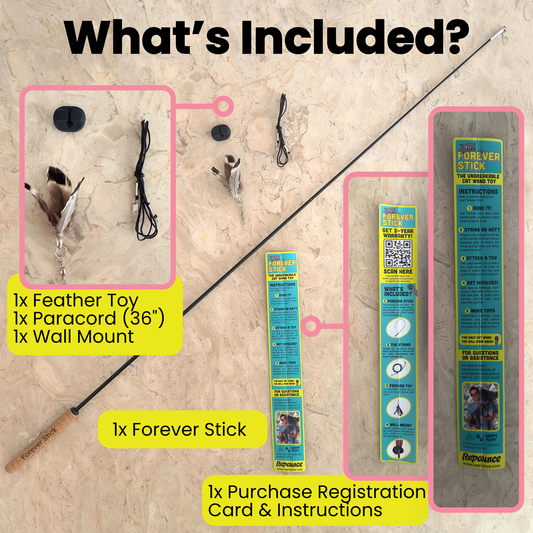
Your main wand. You will use it every day, so it is worth getting a good one. Cheap wands tend to snap at the joint or lose their string within weeks, and then you buy another. Look for a flexible rod that bends and springs back, a comfortable handle, enough reach to keep your hands out of the action, and the option to replace the string and attachments. Our Forever Stick™ was designed around that idea: a durable glass fiber rod, a cork handle and quick clasps, so you replace the worn string or toy and keep the wand.
Toys your cat has proven to love. Once you know your cat's favorite type, buying a well-made version is better than buying five cheap ones.
Where to save
- Experiments: try a new kind of toy cheaply before investing in it.
- Cardboard and paper: boxes, paper bags and tubes cost nothing and many cats prefer them.
- Quantity: a small set of toys rotated regularly beats a big pile your cat stopped noticing.
- Refills over replacements: swapping a worn feather or string costs a fraction of a new toy.
Cheap toys are not always the bargain
A toy that falls apart in a week is not cheap, it is expensive per hour of play, and it can leave loose bits behind. When you compare prices, think about how long the toy will last and whether the parts that wear out can be replaced.
How many toys does a cat need?
Fewer than you might think. A good starting set is one wand with two or three attachments, three or four small toys for solo play, one kicker or plush, and one puzzle toy. Keep about half of the small toys out of sight and swap them every week or so, so they feel new again.
Where you keep toys matters too. Solo toys can live in a low basket your cat can reach. Wand toys belong somewhere out of reach, like a hook or a wall mount, which keeps strings safe and makes the wand feel special when it comes out. Many cats learn to recognize the sound of it coming off the wall and come running.
FAQ
What are the safest toys for cats?
Sturdy toys with no small parts that can come off are the safest for unsupervised play: larger plush toys, solid balls and cardboard. Wand and string toys are safe when you supervise and put them away afterwards. Check all toys regularly for wear.
Are feather toys safe for cats?
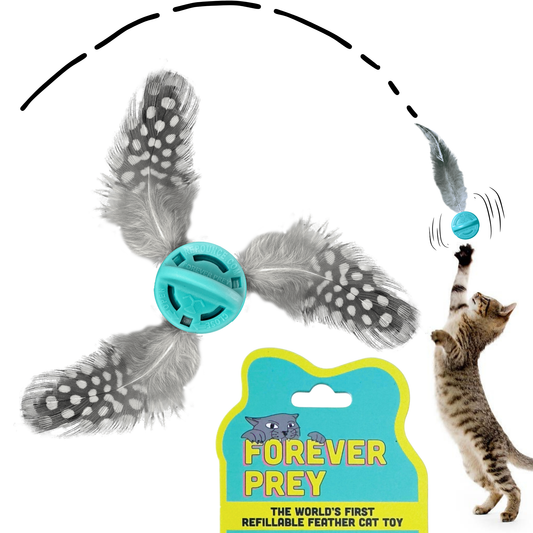
Yes, as long as the feathers are securely attached and you supervise play. Replace feathers once they start to break into small pieces, and take the toy away if your cat begins chewing feathers off rather than chasing.
How much should I spend on cat toys?
There is no set amount, but most of your budget is best spent on one good wand you will use daily. Save on experiments and solo toys, and use free things like boxes and paper bags. Replaceable parts keep long-term costs down.
Why does my cat ignore new toys?
Many toys only come alive when they move like prey, so try playing with the toy yourself rather than leaving it on the floor. Your cat may also prefer a different type of movement or texture. Give a new toy a few tries over several days before giving up on it.
Start small, watch what your cat responds to, and build from there. The right toy is the one your cat keeps coming back to, and that is often simpler than you expect.