Are Cat Wands Good for Cats? Benefits, Risks and How to Choose
Share
Yes, for most cats, wand toys are one of the best toys you can own. They let your cat stalk, chase and pounce on "prey" that you control, which gives indoor cats the exercise and mental stimulation they often miss. The main risks come from strings and unsupervised play, and both are easy to manage.
Below we explain what a cat wand is, why cats respond to it so strongly, what the benefits and risks are, and which cats it suits best. We play with wands every day at home with our two cats, Tolstoy and Gorba, so this is practical experience as much as theory.
What is a cat wand?
A cat wand (also called a teaser wand or fishing pole toy) is a rod with a toy on the end, usually attached by a string. You hold the handle and move the toy, and your cat hunts it. The main types are:
- Feather wands: feathers on a string, good for air play and jumpers.
- String and ribbon wands: a ribbon or cord that snakes along the floor or ripples through the air.
- Short teaser sticks: a toy on a short wire or attached straight to the rod, with no loose string.
- Modular wands: a rod with clasps, so you can swap strings and attachments as your cat's mood or the toy's condition changes.
The rod gives you reach and control, while the string lets the toy move in quick, unpredictable ways that are hard to copy with your hand.
Why cats respond to wand toys
Cats are hunters, even the ones who have never been outside. Hunting follows a sequence: watch, stalk, chase, pounce, catch and bite. Most toys only cover part of it. A ball rolls and stops. A plush mouse just sits there until your cat bats it.
A wand toy can do the whole sequence. It can freeze and twitch so your cat watches and stalks, dash away so they chase, flutter so they leap, and finally let itself be caught. The rustle of feathers or a ribbon along the floor adds sound to the movement. That is why a cat who ignores a basket of toys can suddenly come alive when a wand comes out.
It also matters that a person is moving it. You can respond to your cat, slowing down when they are cautious and speeding up when they are keen, which no toy lying on the floor can do.
The benefits of cat wands
Exercise
Chasing, jumping and pouncing are real exercise. For indoor cats, wand play is one of the easiest ways to keep them moving, which helps with weight and muscle tone. Two or three short sessions of 10 to 15 minutes a day suit most adult cats.
Mental stimulation
Hunting is mentally demanding. Tracking a moving target, planning a pounce and adjusting mid-leap gives your cat's brain a workout, which can help with boredom.
Free: the Playtime Playbook
Our short guide to daily play that keeps indoor cats happy and healthy. Simple routines, no fancy equipment.
Fewer problem behaviors
A bored cat with energy to burn will often find its own entertainment: ambushing ankles, knocking things off shelves or racing around at night. Regular wand play gives that energy somewhere to go, and it teaches your cat to hunt toys rather than hands.
Confidence for shy cats
Because you control the toy, you can start gently from a distance and let a nervous cat win easily. Many shy cats grow bolder with regular, low-pressure play.
Bonding and routine
Cats like predictable routines. A daily play session at the same time becomes something your cat looks forward to, and many owners find their cat seeks them out more once play is a regular habit.
The risks, and how to manage them
Wand toys are safe when you use them sensibly. These are the things to watch:
Swallowed string
This is the big one. If a cat chews and swallows string, it can cause a serious blockage in the gut that needs emergency vet care. Keep string play supervised and put the wand away afterward. If your cat is a keen chewer, our guide to wand strings for cats that chew compares the safer options.
Unsupervised play
A wand left out is an invitation to chew the string, get tangled in it or drag the rod around. Always store it out of reach, on a wall mount or in a closed cupboard.
Broken rods and loose parts
Cheap plastic rods can snap and leave a sharp edge, and glued-on feathers or small parts can come loose and be swallowed. Check the wand before each session and replace worn parts.
Overdoing it
Some cats will keep going past the point of tiredness. If your cat pants, starts breathing with an open mouth or seems sore afterward, stop and let them rest, and talk to your vet if it happens often.
Who cat wands suit
- Indoor cats: probably the cats who benefit most, since they have no outdoor prey to chase.
- Kittens: they love wands. Keep sessions short and never leave strings out with them.
- Adult cats: wand play is a great way to keep them active and engaged as they settle down.
- Senior cats: slow, low ground play keeps them moving gently without big jumps.
- Overweight cats: short, easy sessions are a gentle way to build activity. Check with your vet before starting a new exercise plan.
- Multi-cat homes: you can play with each cat separately so the shy one gets a turn.
Wands are not ideal for a cat who chews and swallows anything string-like. In that case, use a short teaser stick with no loose string, or a chew-resistant string, and stay close. If your cat has arthritis or another health condition, ask your vet what kind of play is suitable.
Choosing a good one
A good wand has a flexible rod that bends instead of snapping, a string attached with a clasp rather than glue, and attachments you can swap or replace. Length matters too: a longer rod keeps your hands out of the action and lets you play from the sofa. We cover all of this in our guide on how to choose a cat wand.
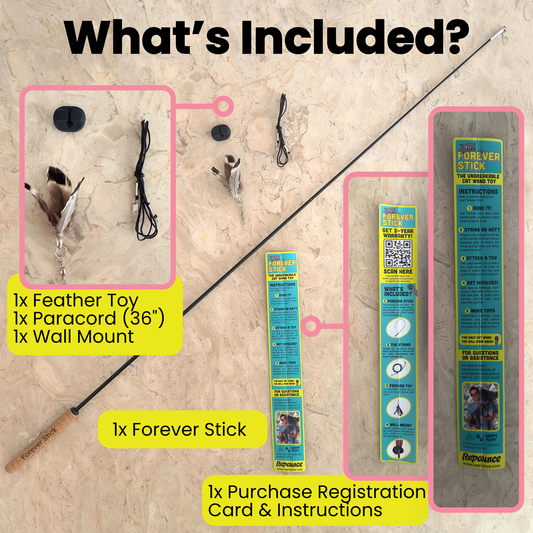
A basic wand from a pet store is a fine way to find out whether your cat enjoys wand play. If your cat is a strong player and cheap wands keep breaking, a sturdier option like our Forever Stick™ lets you replace the string or toy instead of the whole wand.
FAQ
Are wand toys safe for cats?
Yes, when you supervise play and put the wand away afterward. The main danger is a cat chewing and swallowing the string, so never leave a wand out and replace frayed strings.
Can I leave a cat wand out for my cat to play with?
No. Strings left out can be chewed, swallowed or cause tangling, and the toy loses its appeal if it is always lying around. Store it out of reach between sessions.
Are cat wands good for kittens?
Yes, kittens usually adore them, and wand play teaches them to pounce on toys instead of hands. Keep sessions short, supervise closely and store the wand away after every game.
How often should I play with a cat wand?
Two or three short sessions of 10 to 15 minutes a day suit most adult cats. Regular, daily play matters more than long sessions.
If you have never tried one, a wand is a simple way to see your cat's inner hunter.