Cat Toys for Big Cats and Maine Coons: What Holds Up
Share
Big cats and Maine Coons need toys that match their size and strength: wands with longer reach and sturdier rods, attachments closer to the size of real prey, kick toys they can wrap their whole body around, and strings that stand up to chewing. Small, flimsy toys made with an average cat in mind often break in days or simply fail to hold a large cat's interest.
If your cat is a Maine Coon, a Norwegian Forest Cat, a Ragdoll or just a big, powerful house cat, here is what to look for and how to keep play safe.
What large, strong cats need from a toy
A big cat plays like any other cat, just with more force. When a 15-pound cat lands on a toy or yanks a wand string, cheap parts are the first thing to go. Five things make the biggest difference:
- Longer reach. A large cat covers more ground in one leap. A wand with around 36 inches of rod plus a long string keeps the toy moving ahead of the cat and keeps your hand out of range.
- A rod that flexes instead of snapping. Stiff plastic and thin wooden dowels can crack under a heavy cat's grab. A flexible rod absorbs the pull and springs back.
- Prey-sized attachments. A tiny pom-pom can look like a speck to a big cat. Fuller feather clusters and soft toys that are closer to the size of a small bird or mouse often get a stronger reaction.
- Kick toys sized for the cat. A kick toy should be long enough for the cat to hug with the front legs and kick with the back legs at the same time.
- Chew resistance. Strong jaws make short work of thin strings and loosely stitched seams.
Choosing a wand for a big cat
The wand is where size matters most, because it takes the most force. Look at three things.
The rod
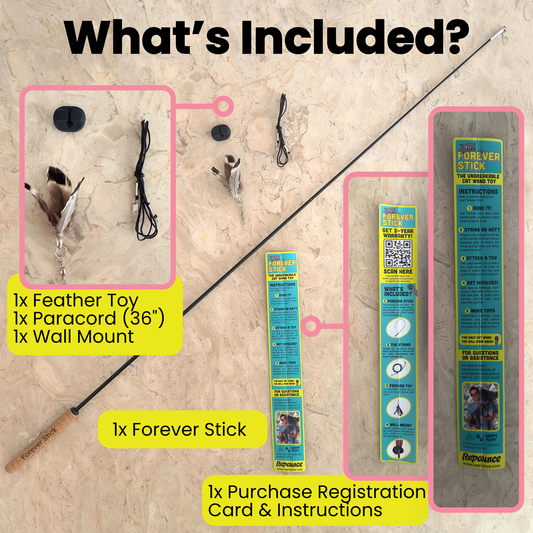
A good rod is sturdy at the handle and springy at the tip. That flex is what lets it survive a big cat hanging on the string. Our Forever Stick™ uses an ultra-flexible glass fiber rod that bends and returns to shape, with 36 inches of reach and a cork handle that stays comfortable during longer sessions.
The string
Strings wear out first on any wand. A replaceable string means you swap that part instead of buying a new toy. The Forever Stick has a detachable 36-inch paracord string, and you can take it off entirely and clip a toy to the tip for fast moves along the floor.
The connection
Check how attachments connect. Knots and glue fail under a strong pull. A clasp that lets you swap attachments, including ones from other brands or a toy your cat already loves, makes the whole setup last longer.
Free: the Playtime Playbook
Our short guide to daily play that keeps indoor cats happy and healthy. Simple routines, no fancy equipment.
Attachments and kick toys that hold up
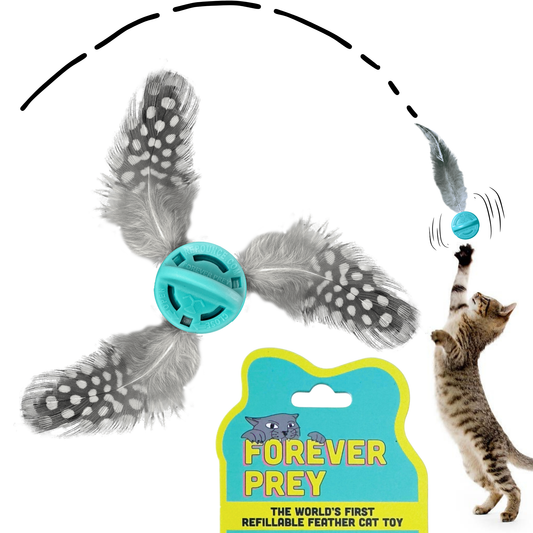
For wand play, many big cats respond best to fuller feather toys and soft attachments they can actually grab and hold. Natural feathers flutter in a way that looks lifelike, and refillable designs like the Forever Prey™ let you replace the feathers once they are chewed instead of throwing away the whole toy.
For solo play, kick toys are a favorite with large cats, who tend to love grabbing a toy and bunny kicking it. Look for reinforced stitching and check the size against your own cat: a kick toy that is too small for a big cat ends up in its mouth rather than in a hug. Our Dino plush has reinforced stitching for bunny kicks and organic catnip, and clips onto a wand when you want to play together.
If your big cat chews
Some cats, large or not, chew on strings during or after play. That wears out toys quickly, and swallowed string is a real hazard. A few steps help:
- Use a chew-resistant string. Our Heavy Chewers Pack includes a chew-proof metal string with a smooth coating, plus two tough nylon options, and fits the Forever Stick and most wands.
- Keep sessions active so the cat chases rather than settles in to chew.
- Let the cat catch and "kill" the toy, then gently move on rather than letting them gnaw on the string.
- Put the wand away after play, every time.
Our guide to wand strings for cats that chew compares the string options in more detail.
Safety for strong players
- Supervise all wand and string play, and store wands out of reach afterward. A wall mount makes this easy.
- Inspect toys often. Replace frayed strings, loose feathers and split seams before they become a problem.
- Avoid small parts like glued-on eyes or bells that a large cat can pull off.
- Clear the space. A big cat at full speed can slide on hard floors or crash into furniture. Play on a rug or an open area.
- Never pull a toy hard from your cat's mouth. Let go of tension and wait for them to release it.
Play tips for big cats
Large cats are often powerful sprinters and enthusiastic wrestlers, but heavier cats may tire faster than smaller ones. Two or three sessions of 10 to 15 minutes a day suit most adult cats, and you can adjust based on how your cat responds.
- Use ground-level play. Dragging a toy along the floor and around corners lets a big cat stalk and pounce without lots of high leaps.
- Keep jumps moderate. Some vertical play is good exercise, but repeated high jumps and hard landings are a lot of load on any cat's joints.
- Let them catch often. A successful catch keeps a big cat motivated and helps them settle afterward.
- Watch for changes. If your cat seems stiff, limps, avoids jumping or suddenly loses interest in play, check with your vet.
FAQ
Do Maine Coons like to play?
Many Maine Coons are known for staying playful well into adulthood, though every cat is different. They often enjoy interactive wand play, fetch-like games and wrestling kick toys. Regular play is a good way to keep any large cat active.
How long should a cat wand be for a big cat?
A rod of around 36 inches plus a long string works well for large cats. It keeps the toy far enough ahead that the cat can run and leap, and keeps your hand out of reach of a powerful grab.
Why does my big cat break toys so fast?
Large cats simply put more force into grabbing, kicking and pulling. Thin strings, stiff rods and loose seams fail first. Choose flexible rods, replaceable strings and reinforced stitching, and swap worn parts early. Our article on why cats destroy toys explains the instinct behind it.
Are catnip kick toys safe for big cats?
Yes, as long as the toy is well made and sized for the cat. Check the seams regularly and replace the toy if it starts to split, so the filling stays inside.
Big cats deserve toys that keep up with them.