What Makes a Cat Wand Truly Durable? Materials, Build & Design Explained
Share
Durability is one of those words that appears on almost every cat wand listing but is rarely explained. What does it actually mean for a wand to be durable? What materials hold up? What construction choices make the difference between a toy that lasts days and one that lasts years?
This guide breaks it down component by component so you know exactly what to look for, and what to avoid.
The Four Components That Determine Durability
Every cat wand has four structural components that determine how long it lasts: the rod, the string, the hardware, and the attachment system. Durability is determined by the weakest of the four — which is why a wand with one excellent component and three poor ones will still fail quickly.
1. The Rod, The Backbone
The rod is subjected to lateral flex stress every single play session. When your cat pounces at the bait and the string goes taut, the rod bends. When the cat misses and the tension releases, the rod springs back. This cycle repeats hundreds of times per session and thousands of times per month.
The material has to handle this without accumulating damage. Here's how the main options compare:
| Material | Flex Response | Safety on Break |
| Hollow Plastic | Resists, then snaps | Sharp Edge - unsafe |
| Solid Plastic | Slightly better but still brittle | Sharp Edge - unsafe |
| Wood | Prone to splintering | Splinters - unsafe |
| Fiberglass / Glass fiber composite | Flexes without cracking | Bends, doesn't snap |
| Carbon Fiber | Extremely Stiff, minimal flex | Can crack under extreme impact |
For cat wands, glass fiber reinforced composite is the optimal material. It's flexible enough to produce the natural, prey-like movement cats respond to, durable enough to handle daily play indefinitely, and safe in the event of any stress — it bends rather than snapping to a sharp point.
2. The String, The Consumable
Unlike the rod, the string is designed to be a consumable, it should be replaceable, and will need periodic replacement. The question is not which string lasts forever, but which string lasts long enough to justify the wand's price and is available as a replacement part.
- Nylon paracord is the correct choice. It has high tensile strength, resists fraying at connection points, handles biting and pulling without rapid degradation, and is inexpensive to replace.
- Thin ribbon degrades quickly under repeated biting. The fibres separate at points of repeated stress, typically first at the connection to the wand tip.
- Cotton cord is soft and pleasant to handle but has poor resistance to moisture (saliva) and will fray significantly faster than nylon under the same conditions.
- Elastic or rubber strings feel novel but have poor resistance to repeated stretching and biting and typically fail within weeks.
3. The Hardware, The Hidden Failure Point
Hardware is the most overlooked durability factor in cat wands and the most common source of unexpected failure. Every junction between components, rod tip to string, string to attachment, any swivel or clasp, is a stress concentration point. The material at these junctions matters enormously.
Solid metal hardware at every connection point is non-negotiable for a durable wand. This means a metal eyelet or ring at the rod tip (not a drilled hole), a metal swivel to prevent string twist, and a metal clasp for the bait attachment.
Plastic hardware looks identical to metal in most product photos and degrades in three ways: cracking under mechanical stress, seizing from saliva exposure, and wearing through at contact surfaces. The average plastic connector on a budget wand fails within 4–8 weeks of daily play.
4. The Attachment System, Modular vs Fixed
This is the design choice that most determines long-term durability in practical terms. A fixed attachment, feathers or a bait glued or sewn to the string with no quick-release mechanism, becomes a single point of failure. When the attachment wears out (which it will, because cats are rough with attachments), the entire toy is finished.
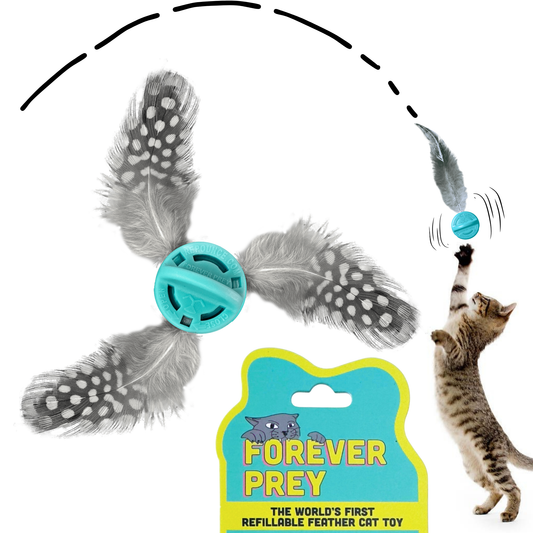
A modular attachment system, where the bait connects to the string via a quick clasp and can be removed and replaced in seconds, means the wand itself has essentially unlimited lifespan. You're replacing a $5 feather set every few weeks, not a $35 wand.
Beyond durability, modularity has a second benefit: variety. Different attachments trigger different hunting responses in cats. A feather set activates aerial hunting. A ribbon set activates ground stalking. A plush mouse attachment activates the kill-and-carry sequence. A modular wand lets you run through the full prey sequence with a single product.
The Design Philosophy That Makes It All Work
The most durable cat wand isn't the one made from the single best material. It's the one designed with the understanding that different components have different lifespans, and that the expensive, structural components should never need replacing while the inexpensive consumable components should be cheap and easy to swap.
This is the philosophy behind the Forever Stick: a glass fiber rod guaranteed for life, a replaceable nylon paracord string, solid metal hardware, and a universal modular attachment system. The wand is designed to be a one-time purchase. The strings and attachments are designed to be affordable, available, and easy to replace.
Frequently Asked Questions
What material is the most durable for a cat wand rod?
Glass fiber reinforced composite is the optimal material for a cat wand rod. It flexes without cracking under repeated play stress, lasts indefinitely under normal conditions, and bends rather than snapping to a sharp point. Fiberglass and carbon fiber are strong alternatives, though carbon fiber is more rigid and can crack under extreme impact.
Should I look for a cat wand with replaceable parts?
Yes, this is the single most important feature for long-term durability. A wand with a lifetime rod guarantee and separately available replacement strings and attachments will cost significantly less over any 12-month period than a fixed-design wand that must be replaced entirely when any component wears out.
What's the difference between fiberglass and carbon fiber cat wand rods?
Both are significantly more durable than plastic. Fiberglass is more flexible and better suited to the whipping motion of cat wand play. Carbon fiber is stiffer and lighter but can crack under sharp lateral impact. For cat wands specifically, a flexible glass fiber composite is generally preferred over rigid carbon fiber.